Email marketing ROI: Beyond the 42:1 rule

-
- What is email marketing return on investment + a formula for you
- Best practices for tracking email marketing ROI
- How to improve your email marketing ROI at each stage
- When to optimize vs when to keep going
- Start tracking your email marketing ROI (your way)
- Frequently asked questions about email marketing ROI
You’ve seen the stat. “$42 for every $1 spent on email marketing.” It’s everywhere: on LinkedIn, in case studies, probably tattooed on some growth hacker’s forearm.
And if you’re three months into building your email list with 287 subscribers, sending campaigns to crickets, and wondering if you’re doing something catastrophically wrong, that number feels like a personal attack.
Here’s what nobody mentions: That 42:1 average is just an average across thousands of businesses at different stages. It doesn’t tell you anything about where you should be in month 3 or year 1. You’re in year 1, trying to write a personalized subject line that doesn’t sound desperate.
This guide shows you what email marketing return on investment (ROI) actually measures, how to track the three numbers that matter for YOUR stage, and when your results are good enough to keep going versus when something needs fixing. You’ll learn why comparing your month 2 to someone else’s year 5 is pointless, and what to measure instead.
Let’s figure out what good ROI looks like for where you actually are.
Key takeaways:
- The $42 for every $1 average is from year 5 businesses with massive lists – Stop comparing your early results to mature programs.
- Track 3 numbers monthly: list growth rate, email-attributed revenue, and costs – ignore everything else until these are solid.
- Realistic ROI by stage: Year 1 (100-200%), year 2 (300-500%), year 3+ (1000%+) – compare yourself to last quarter, not industry averages.
- Even 2:1 ROI in year 1 means it’s working – if you’re making more than you’re spending, keep going.
- 15-minute monthly check-in: track your numbers, calculate ROI, note what worked – consistency beats perfection.
What is email marketing return on investment + a formula for you
Email marketing ROI is a metric that measures how much revenue you generate compared to what you spend on email marketing campaigns. It’s expressed as a percentage, so 400% ROI means you made $4 for every $1 you spent.
The email marketing ROI formula:
(Revenue from email − Email costs) ÷ Email costs × 100
- Costs include: Your email platform subscription, time spent creating campaigns, design or content work, and any list management tools.
- Revenue includes: Direct sales from email links, repeat purchases from lead nurturing email sequences, and retained customers who stay engaged through email.
Here’s how it works in practice: Let’s say you spend $200/month between your platform fee and the time you invest in creating campaigns. Your emails generate $1,200 in tracked sales that month.
ROI = ($1,200 − $200) ÷ $200 × 100 = 500%
That’s $5 back for every $1 spent. Not the famous 42:1, but profitable for a growing business.
Best practices for tracking email marketing ROI
You’ve got the formula. Here’s how to use it without overcomplicating things or panicking at every dip you see in your email marketing platform’s analytics page.
1. Start with a baseline measurement
Before you can improve anything, you need to know where you’re starting. Pick a month (ideally your first full month of consistent emailing) and calculate your ROI using the formula above. Write it down. This becomes your baseline: the number you’ll compare future months against. It doesn’t matter if it’s negative or barely positive. You just need a starting point to measure progress.
Let’s say you run a small online store selling handmade jewelry.
- In your first full month, you spent $30 on your email platform and invested about 20 hours setting up your account, designing a template, creating a welcome email sequence, and sending your first few email marketing campaigns. At $25/hour, that’s $500 of your time. Total cost: $530.
- Your welcome sequence and product launch email generated $900 in tracked sales. Your baseline ROI: ($900 − $530) ÷ $530 × 100 = 70%.
Not breaking records, but you’re building something. And now you have a number to beat next month as your systems get more efficient.
2. Track trends, not daily fluctuations
Email marketing ROI isn’t like checking your stock portfolio every hour. One bad week doesn’t mean your email marketing strategy is failing, and one great campaign doesn’t mean you’ve cracked the code. Look at month-over-month trends instead. Is your ROI moving up over three months? Six months? That’s what matters. Daily or weekly swings are normal noise, especially for small businesses with smaller lists.
That jewelry store owner with 70% ROI in month 1? Month 2 drops to 45% (holiday slow season, only 8 hours of work needed). Month 3 jumps to 110% (Mother’s Day campaign, 10 hours invested). Month 4 lands at 95%. If you only looked at month 2, you’d panic and quit. But the three-month trend shows 70% → 45% → 110% → 95%, which is an overall movement up, and time investment is decreasing. That’s what matters.
3. Set realistic benchmarks for your stage
If you’re three months into building your email list, comparing yourself to the “$42 for every $1” industry average is pointless. That number reflects mature, optimized email programs; not someone just starting out.
Email marketing ROI is like building a business: A new freelancer just landing their first customers won’t have the same revenue as someone with three years of repeat customers. A blogger with 200 subscribers won’t see the same results as one with 5,000 engaged readers. The metric is the same, but the expectations should match your own reality.
Here’s what realistic email marketing benchmarks look like by stage:
- Year 1: Breaking even or slightly positive ROI (100-200%) is solid progress. You’re still learning what connects with your audience.
- Year 2: 300-500% ROI becomes achievable as you refine your approach and your list matures.
- Year 3+: This is when 1000%+ ROI (the famous 10:1 or higher) becomes realistic for well-run email programs.
Your real benchmark isn’t an industry average — it’s whether you’re improving quarter over quarter at your current stage.
4. Track the three metrics that matter
You don’t need to monitor 15 different metrics to know if email marketing is working. Email open rates, click rates, bounce rates, unsubscribe rates. Sure, they’re useful, but for ROI tracking, you need three numbers:
1. List growth rate
How many new recipients you’re adding each month. If you started January with 500 subscribers and ended with 550, you added 50 people: that’s a 10% growth rate. A growing list means more potential revenue. If your list is shrinking or stagnant, your ROI will eventually plateau. Check your total subscribers on the first of each month in your email platform dashboard.
2. Email-attributed revenue
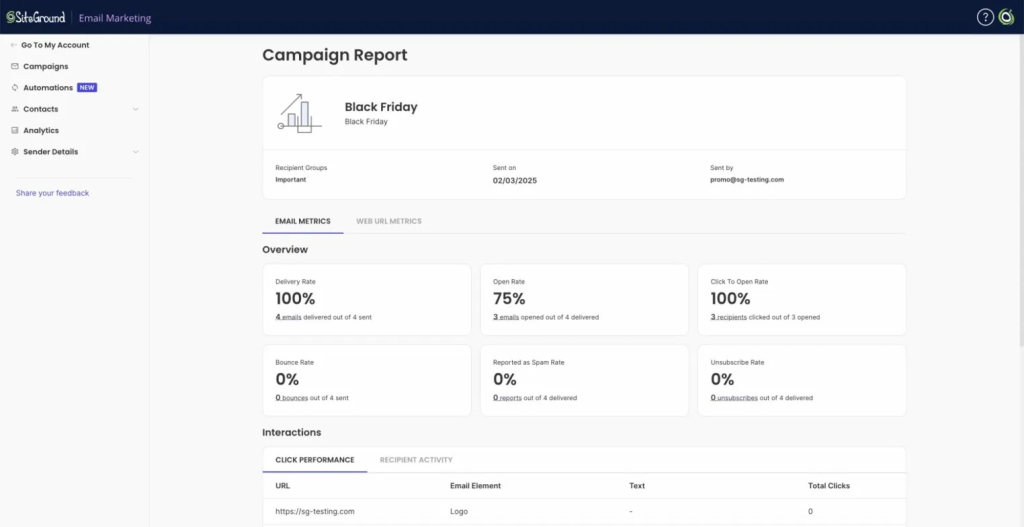
These are the sales generated after you send campaigns. This is the “revenue” part of your ROI formula. You’ll track this through your sales platform or website analytics. The simplest method: note when you send emails, then check for sales spikes in your store on those days. For more precision, use unique discount codes in each campaign (like JUNE10) and track how many times they’re redeemed.
SiteGround Email Marketing shows you campaign performance metrics like which links people clicked, helping you track engagement—but connecting those clicks to actual sales happens in your ecommerce platform.
3. Monthly costs
Your email platform subscription plus a realistic estimate of the time you spend creating email marketing campaigns. If you pay someone to design or write emails, include that too. Most people underestimate their time investment, which makes their ROI look artificially high.
When your platform is easier to use, you spend fewer hours creating campaigns—which directly lowers your monthly costs and improves your ROI. With SiteGround Email Marketing‘s no-code builder and AI text writer, you can cut your design time from 3 hours to 30 minutes. Over a year, that’s 30+ hours saved—worth $750+ if your time is valued at $25/hour.
That’s it. Three numbers, once a month, 15 minutes. Spending two hours every week analyzing micro-metrics won’t improve your ROI as much as spending that time writing better marketing emails.
How to improve your email marketing ROI at each stage
Remember those stages we just talked about? Each one requires a different approach. What improves ROI in year 1 won’t be the same as what works in year 3.
Year 1: Focus on list building and learning what connects
At this stage, you’re still figuring out what your audience responds to. Test different email subject lines to see what gets opens. Try various content formats: educational tips, behind-the-scenes stories, product showcases, and track which ones drive clicks. Find your voice. Don’t worry about advanced segmentation yet.
Just send consistently, pay attention to what works, and grow your list. If you’re that freelancer landing your first customers or the blogger with 200 subscribers, this is where you build the foundation.
Year 2: Optimize based on patterns
Now you’ve got data. You know which emails people open, which links they click, and what type of content leads to sales. This is when you start segmenting your list: maybe by purchase history, email engagement level, or interests.
With SiteGround Email Marketing, you can set up email automation triggered when contacts join specific groups. This is perfect for sending a welcome email series, onboarding sequence, or introducing your best content over several days.
You’re refining what worked in year 1 and cutting what didn’t.
Year 3+: Scale what works
By now, you’ve got proven email marketing campaigns and a substantial list. Expand your successful campaigns. If a product launch email sequence worked once, use that template again. Refine your targeting based on years of behavior data.
This is when that 10:1 ROI becomes realistic because you’re running a system, not experimenting.
Why comparing your month 2 to someone else’s year 5 doesn’t help
Someone in year 5 has thousands of subscribers, proven email sequences, and refined targeting. You’re still testing subject lines. Their email ROI reflects years of compound growth: a larger list, repeat customers, and automated systems. Comparing your early results to their mature program just makes you feel behind when you’re actually right on track for your stage.
Your 15-minute monthly check-in
Set aside 15 minutes on the first of each month to track your progress:
| Task | Time | What to do |
| Track your numbers | 2 min | List growth rate: ___ Email-attributed revenue: $___ Monthly costs: $___ |
| Calculate ROI | 2 min | (Revenue − Costs) ÷ Costs × 100 = ___% |
| Compare to last month | 1 min | Trending: ☐ Up ☐ Down ☐ Steady |
| Reflect and plan | 10 min | What worked well this month: One thing to test next month: |
This simple habit keeps you focused on progress without getting lost in daily fluctuations or vanity metrics.
When to optimize vs when to keep going
Not every dip in performance means your strategy is broken. Sometimes the best move is to stay the course. Here’s how to tell the difference.
Green flags: Signs your email campaigns are working ✅
If you’re seeing these patterns, keep doing what you’re doing:
- Revenue is trending up – Even if it’s slow growth, upward movement over three to six months means your emails are contributing to sales. A $200 increase one month and $150 the next isn’t failure — it’s progress.
- Your list is growing – New subscribers joining consistently (even if it’s just 10-20 per month for small businesses) signals that people want to hear from you. Growth doesn’t have to be explosive to be healthy.
- Engagement is holding steady – Your open rates and click rates don’t need to climb every month. If they’re consistent, say, 20-25% open rate month after month, that’s a good sign. People are still interested in what you’re sending.
When you see these green flags, resist the urge to overhaul everything. Small tweaks are fine, but major changes can disrupt what’s already working.
Yellow flags: When to dig deeper ⚠️
These patterns suggest it’s time to investigate and adjust:
- Stagnant open rates for 3+ months – If your opens have flatlined or dropped and stayed low, your subject lines might need work, or you’re sending at the wrong times. Test different approaches before assuming your audience lost interest.
- No sales from recent campaigns – If you’ve sent five promotional emails in a row with zero conversions, something’s off. Maybe your offers don’t match what your target audience needs, or your email-to-landing-page experience has friction.
- List growth has stopped – If you haven’t added new subscribers in weeks, your lead magnets or signup forms might need refreshing. Or you’ve stopped promoting them.
The “it’s working” threshold for small businesses
Here’s a simple test: Are you making more from email than you’re spending on it? If yes, it’s working. You don’t need 42:1 ROI to justify continuing. Even 2:1 or 3:1 ROI in year 1 means email is pulling its weight compared to other marketing channels. Keep going, keep learning, and let the compound effects build over time.
Start tracking your email marketing ROI (your way)
You’ve got the formula. You know what to track. You understand why month 3 looks nothing like year 3.
Now actually do it. Open a spreadsheet or note on your phone. Write down your current subscriber count, last month’s email revenue, and your costs. Calculate the percentage. That’s your baseline.
Next month, do it again. The month after that, do it again. Fifteen minutes of paying attention to whether things are moving in the right direction.
Good email marketing ROI isn’t about perfect campaigns or advanced tactics. It’s about sending emails consistently and tracking those three numbers every month to see if you’re improving. And here’s the part most people overlook: the less time you spend creating each campaign, the lower your costs—which directly increases your ROI. Cut your campaign creation time in half, and you’ve just improved your ROI without changing anything else.
The businesses that hit impressive numbers in year 3? They’re the ones who tracked their modest numbers in year 1, kept going anyway, and found ways to work more efficiently.
SiteGround Email Marketing is built exactly for this: the no-code builder and AI text writer reduce your time per campaign, the dashboard shows you engagement at a glance, and when you’re ready for year 2 optimization, you can set up automated sequences without technical skills. Less time spent = lower costs = better ROI, even if your revenue stays the same.
Your way works if you stick with it long enough to let it work.
Improve Your Email Campaigns with SiteGround!
Want your emails to reach more people? Try SiteGround Email Marketing. With an average delivery rate of 98.8%, your emails will land in your subscribers' inboxes. 
Frequently asked questions about email marketing ROI
The commonly cited average ROI for email marketing is $42 for every $1 spent, but this reflects mature, optimized programs. Your email ROI depends on list size, industry, and how long you’ve been running campaigns. Compare your results to your own past performance, not industry averages.
Most small businesses see positive ROI within 6-12 months. Year 1 typically brings 100-200% ROI as you build and learn. By year 2, 300-500% ROI becomes achievable with a larger list and refined approach.
Negative ROI in months 1-3 is normal. You’re investing to build your list and test what works. If you’re still negative after 6 months, review your email frequency, content quality, and sales timing.
It depends on the list size and what you sell. A rough estimate: 1,000 engaged subscribers might generate $1,000-$3,000 monthly for ecommerce, or $500-$2,000 for services. Larger lists (10,000+) with strong engagement can generate $10,000-$50,000+ monthly.





Comments ( 0 )
Thanks! Your comment will be held for moderation and will be shortly published, if it is related to this blog article. Comments for support inquiries or issues will not be published, if you have such please report it through our official channels of communication.
Leave a comment
Thanks! Your comment will be held for moderation and will be shortly published, if it is related to this blog article. Comments for support inquiries or issues will not be published, if you have such please report it through our official channels of communication.