Make them laugh: Adding humor in email marketing

-
- Why humor actually works in emails
- 5 types of humor that work in email marketing
- Subject line humor vs. body copy humor: Two different skills
- Map your humor to the right moment
- Priming your audience for humor
- 5 rules to not make it weird
- What to avoid (seriously)
- How to measure if your humor is working
- Where to start with humor in your emails
When you plan an email, it’s easy to focus on the offer, the segment, and the subject line. It’s also easy to forget there’s a real person on the other side deciding, in a second, whether they feel like reading any of it.
Humor is one of the few tools that can change that feeling quickly, even though it’s not always easy to pull off. In this article, we’ll look at a handful of humor styles that work in email and how to use them intentionally. For small businesses, that can lead to higher opens, more clicks, and a brand people actually remember when they need what you sell.
Key takeaways:
- Humor works when it mirrors your reader’s actual life and frustrations, so the email makes people feel understood, not marketed at.
- Choose one humor style per email (self-own, pain point, pun, inside joke, or twist) and make sure it points back to a clear message or offer.
- Don’t sacrifice clarity for cleverness, if the joke makes the point harder to understand, cut the joke.
- Measure if humor works by tracking opens, clicks, replies, unsubscribes, and forwards against your normal benchmarks.
Why humor actually works in emails
When an email makes you smile, you don’t experience it as “marketing” first but as a human moment. But the deeper reason humor works has nothing to do with comedy. It’s about recognition.
When you make someone laugh, you’re proving you understand them: their day, their frustrations, their industry, the specific kind of tired they are on a Tuesday afternoon. As conversion copywriter Lianna Patch puts it: “People don’t buy products. They buy feelings that come with them.” Laughter is one of the fastest ways to create that feeling.
According to Oracle’s Happiness Report, 72% of people would choose a brand that makes them laugh over a competitor. That’s a majority of your potential customers actively rewarding brands that don’t take themselves too seriously.
That’s the emotional core of good email marketing, humor or not. Laughter is just the shortcut.
The key insight
Humor is an emotional signal. It tells your subscriber: I wrote this for you specifically, not for a generic person who might be on my list. That signal is what builds the kind of loyalty no discount code can buy.
5 types of humor that work in email marketing
Not all humor is equal. Different styles work for different audiences and moments.
1. Self-deprecating humor (the safest kind)
Poking fun at your own product, your team, or your industry is low-risk and high-reward. It signals confidence, honesty, and humanity, three things marketing copy is usually missing.
The structure is simple: admit something true that’s slightly unflattering, then own it completely. A re‑engagement email that says, “We noticed you haven’t opened lately. We cried a little, ate a cookie, and decided to win you back” injects vulnerability and charm into what’s usually a dry message. Humor makes the outreach feel personal.
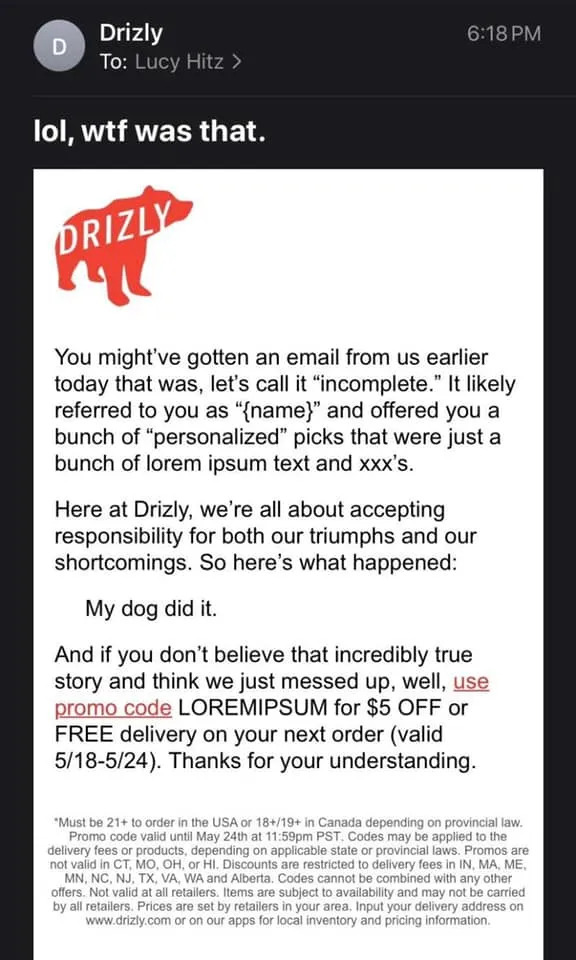
Online liquor store Drizly once sent an email full of lorem ipsum by mistake, then followed up with “lol, wtf was that” and a discount code called LOREMIPSUM. They turned an error into a self-deprecating moment that actually made subscribers like them more.
2. Pain-point humor (the most effective kind)
Take a real frustration your audience lives with and exaggerate it until it becomes absurd. This works because of recognition. When someone reads a copy that names their exact problem — not a vague approximation of it, the specific Tuesday-at-4pm version of it — they feel seen. And feeling seen is the fastest path to a click.
A fitness coach can mock the gap between January gym motivation and February reality. A web designer can joke about exported files named “FINAL” and “FINAL FINAL v3”. If your audience has felt it, you can joke about it.
Death Wish Coffee has framed running out of coffee like a horror movie plot, riffing on Friday the 13th in their emails. It’s funny because the fear is real for their audience: they’re exaggerating a genuine pain point, not inventing one.

3. Puns and wordplay (use sparingly, but use them)
Everyone rolls their eyes at puns. Everyone secretly enjoys them. That little eye-roll? It means the pun worked. It caught their attention, made them react, and that’s what makes it memorable.
Research consistently shows pun-based subject lines outperform generic ones (even the obvious ones) because they create a micro-moment of surprise that breaks the monotony of the inbox.
Subject line examples that work:
- Florist: “We’re rooting for you 🌱”
- Coffee brand: “Espresso yourself.”
- Pet shop: “Pawsome deals end Sunday.”
The rule: a pun earns its place when it connects to something real in the email. A pun that exists just for the joke misses the point. A pun that bridges your subject line to your actual offer is a hook.
4. Inside jokes (the most bonding kind)
Nothing signals “I’m one of you” faster than a joke only your audience would get. Industry-specific humor: references to shared tools, shared nightmares, shared jargon — creates a sense of belonging that generic content never can.
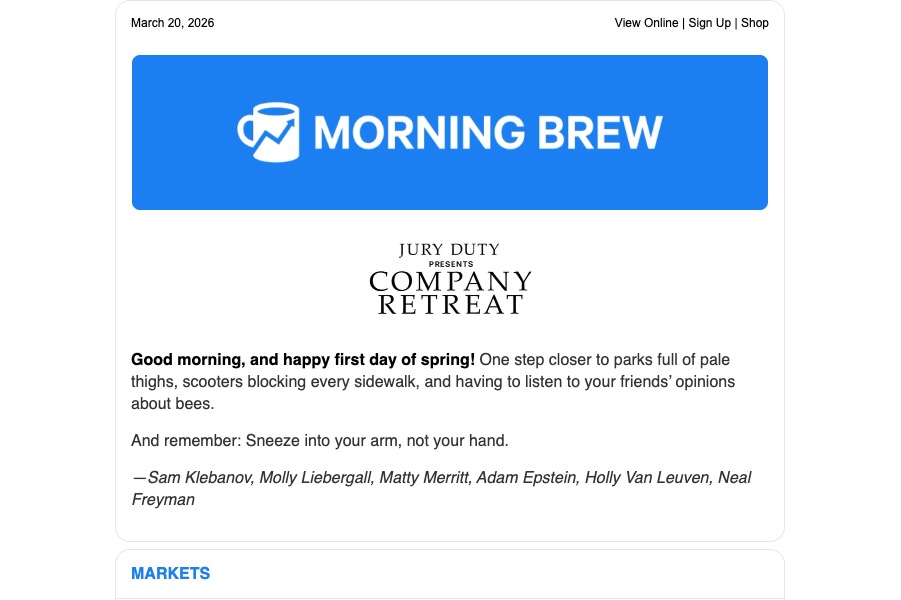
Morning Brew, for example, constantly winks to finance in-jokes, niche business memes, and recurring “characters” in the news cycle, jokes that make no sense unless you’ve been following along.
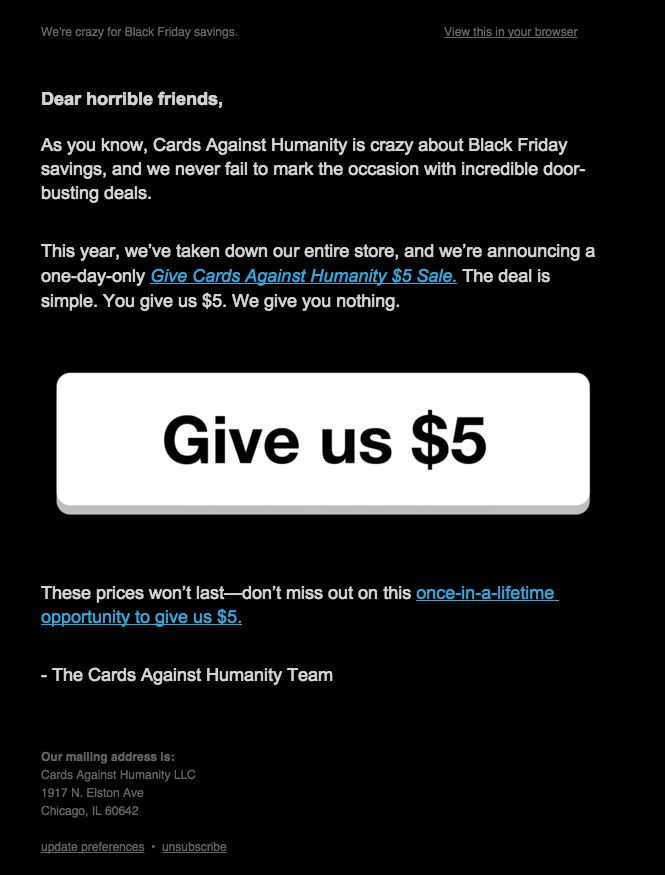
And Cards Against Humanity has turned ridiculous Black Friday stunts into a tradition their audience feels part of: charging more, selling nothing, or listing ridiculous items. Both have built cult-level loyalty partly because of it.
For small business owners: what’s the joke only your customers would get? The one that’s so niche it would mean nothing to anyone outside your world? That’s the joke worth putting in an email.
5. The unexpected twist (the most shareable kind)
Set up an expectation. Break it.
The twist works because it rewards attention. Subscribers who read all the way through feel like they got something: a joke, a reveal, a moment of surprise. That feeling makes them more likely to click, more likely to remember you, and significantly more likely to forward the email to a friend.
Think: a “50% off” subject line that turns out, in the body copy, to be “50% off… your stress, because this tool now does the boring part for you,” then smoothly pivots into the actual (smaller but still real) discount.
Subject line humor vs. body copy humor: Two different skills
Most advice on funny emails treats subject lines and body copy as the same thing. They’re not. Getting one right doesn’t automatically mean you’ll get the other right and mixing up the approach is one of the most common reasons a “humorous” email falls flat.
Subject line humor
A subject line has roughly 40–50 characters to do everything: earn the open, set a tone, and create enough curiosity or recognition that clicking feels like the obvious next move.
This means subject line humor needs to be immediate. The joke has to land on the first read, without setup. The formats that work best here are:
Bluntly honest confessions
“This is a shameless bribe to open” or “Yes, this is a sales email” call out what’s happening and disarm skepticism in one line.
Broken clichés and flipped phrases
Take something familiar and twist it once, like “New year, same beautiful chaos” or “Limited-time offer (for real this time).”
Exaggerated overreactions
Lines like “Everything is under control (we think)” or “We need to talk about your cart” heighten a small situation just enough to be funny, not confusing.
What doesn’t work: jokes that require context to land, references that only make sense if you already know what the email is about, or wordplay so layered it needs a second read. In a subject line, if someone has to think, you’ve already lost them.
Body copy humor
Email body copy humor has the opposite problem. You have room which means you have enough rope to hang yourself with. The risk isn’t that the joke won’t land, it’s that you’ll keep going after it lands, explaining it into the ground, and arriving at your email CTA with no momentum left.
Good body copy humor follows a three-beat structure:
- Setup: Establish the bit. Name the pain, the absurdity, or the premise. Keep it short, one or two sentences maximum.
- Payoff: The punchline, the reveal, or the escalation. This is the moment the reader rewards you with a smile. It should arrive before they expect it.
- Pivot: The clean turn toward your actual point. This is where most brands lose the thread. They stay in the joke too long and the CTA doesn’t feel like the obvious next step anymore. The pivot should feel like the natural conclusion of the joke.
Map your humor to the right moment
Humor is an emotion, and emotions belong in specific places in your marketing funnel.
- Welcome emails: Self-deprecating humor sets your voice immediately. It tells subscribers what kind of relationship this is going to be.
- Promotional emails: Pain-point humor makes the problem feel real before your solution feels necessary. The joke is the setup, your offer is the punchline.
- Re-engagement campaigns: Unexpected twists and a light tone work best here. Your subscriber has gone quiet — a funny email feels lower-stakes to respond to than a serious one.
- Post-purchase follow-ups: The customer is happy, their guard is down. A funny follow-up deepens loyalty without asking for anything.
- April Fools (and cultural moments): The rare occasion when everyone expects something different from their inbox. Your subscribers are primed. The bar is lower. Use it.
Priming your audience for humor
Humor lands differently depending on what your subscribers expect from you. If your tone has always been polished and professional, going playful without warning can feel jarring — like a stranger cracking a joke in a business meeting.
The solution is a permission layer: a few small signals that tell your audience your voice is loosening up, before it actually does:
- Add a PS line with a light touch. A single line at the end of an otherwise normal email — something like “PS. We’re working on something a little different for next week. Just saying.” — plants a seed without committing to anything. It also gets opened: PS lines have disproportionately high read rates because they feel personal.
- Let one sentence breathe. In your next regular email, swap one stiff, formal sentence for something slightly more human. “Honestly, this one took us a while to get right.” That’s enough. It starts recalibrating what subscribers expect from your voice.
- Reference your audience’s reality, not just their goals. Most marketing emails speak to where subscribers want to be. One sentence about where they actually are: the frustration, the Monday morning feeling, the thing that’s not working yet, builds the kind of recognition that makes humor land when it arrives.
The permission layer matters most for two groups: new subscribers (who haven’t established a relationship with your voice yet) and long-term subscribers who joined during a more formal era of your brand. For everyone else who already expects warmth and personality from you, you can skip it.
The timing principle
You don’t need to warm up your entire list before one April Fools email. But if humor is going to become a regular part of your email marketing strategy, not just a one-off, the permission layer is what prevents the tonal whiplash that increases unsubscribes over time. Build the relationship first. Then make them laugh.
5 rules to not make it weird
1. Anchor every joke to something real
Every joke should connect to a real pain, a real product, or a real benefit. If you removed the humor, the email should still make sense.
2. Don’t sacrifice clarity for cleverness
If a subscriber has to decode the joke to understand what you’re selling, you’ve lost them. Funny subject line, clear email body. Never the other way around.
3. Know what your audience finds funny
A meme that lands with 25-year-old freelancers may confuse a 55-year-old dentist. Test with a small segment first.
4. Humor is hot sauce, not the main course
One strong humor moment per email. If every line is a gag, the offer disappears. The joke is the hook; the value is why they stay.
5. Test on 3 real humans before sending
If they don’t immediately “get it” — rewrite. Explained humor is dead humor. Always test outside your own bubble.
What to avoid (seriously)
✓ Do this
- Joke about your failures, not your customer’s
- Use humor in the subject line, then deliver value in the body
- Lean on audience-specific references (insider jokes)
- Use a warm, honest disclaimer when it’s a prank
- A/B test your humorous vs. standard subject lines
X Avoid this
- Cultural, political, or religious references
- Humor that punches at a group (even lightly)
- Sarcasm without a clear signal — it reads as rude in plain text
- Over-explaining the joke (this is worse than the joke itself)
- Humor that has nothing to do with your offer
- Forcing humor in genuinely serious communications
How to measure if your humor is working
You don’t just want laughs, you want conversions. Here’s the email marketing benchmarks to watch:
- Email open rate: Did the funny subject line work? Compare against your average.
- Click-through rate: Did they engage, or just laugh and close? A spike in opens with flat CTR means your humor didn’t connect to the offer.
- Reply rate: Positive replies are the strongest signal. Humor makes people respond.
- Unsubscribe rate: A small spike is normal for anything unusual. A big spike means you missed the mark.
- Forward/share rate: The ultimate proof, did subscribers share it?
Where to start with humor in your emails
At the end of the day, “funny” isn’t the goal. “Remembered,” “clicked,” and “bought again” are the goals, humor is just one way to get there.
A line that makes them smile, a subject line that surprises them a little, that’s often enough to tip the balance toward an open or a click.
Start small. Test one funny subject line against your usual one. Add a single joke to your next welcome email and see how people respond. Over time, you’ll figure out what your audience actually laughs at, not what a marketer on the internet told you should be funny.
Your subscribers are people. They have a sense of humor. Give them credit for it.




Comments ( 0 )
Thanks! Your comment will be held for moderation and will be shortly published, if it is related to this blog article. Comments for support inquiries or issues will not be published, if you have such please report it through our official channels of communication.
Leave a comment
Thanks! Your comment will be held for moderation and will be shortly published, if it is related to this blog article. Comments for support inquiries or issues will not be published, if you have such please report it through our official channels of communication.