20 email closings that reinforce your brand + cheat sheet
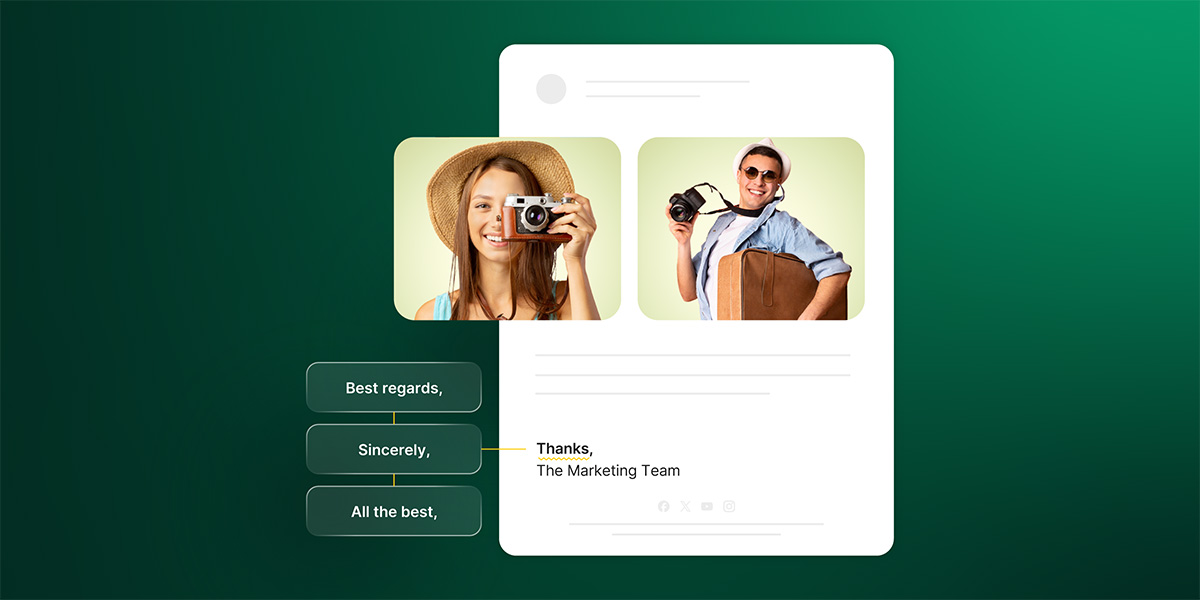
Most small business owners treat email closings like an afterthought. You type “Best” or “Thanks,” hit send, done.
But that closing does more than fill space before your email signature. It reinforces your message, signals your brand voice, and influences whether people take action. It’s not just politeness—it’s a tool most people don’t use intentionally.
For solopreneurs and bloggers running email campaigns, this can make a difference. Your welcome email closing sets the tone for everything that follows. Your newsletter sign-off reminds people why they’re here. Your sales email closing can tip someone from “maybe” to “yes.”
Here’s what email closings actually do, how to use them strategically in your campaigns, and how to create one that reinforces your brand. Plus a cheat sheet for every email type, the psychology behind why certain closings work, and the 15 that quietly damage your credibility.
Key takeaways:
- Your closing reinforces your message and influences action—it’s not just politeness.
- Match closings to email type—welcome emails need different sign-offs than product launches.
- Create a signature closing—”Keep creating,” “To better emails”—that reflects your brand.
- Generation matters—Gen Z prefers casual, Boomers expect formal.
- Personalize standard closings—add specificity to make them yours.
What is an email closing?
An email closing (also called an email sign-off) is the final phrase you write before your name at the end of an email message. It serves as the conclusion to your communication and is your opportunity to reinforce the right tone, reinforce your professionalism, and leave a lasting impression on the recipient before they move on to their next email.

Your closing gets less attention than other parts of your email like subject line or body copy, but it does just as much work. It signals respect, reinforces your tone, and tells recipients how formal or casual your relationship is. Skip it, and your email feels abrupt. Choose the wrong one, and you might seem off-brand or unprofessional.
Most closings are short—one to four words, a comma, then your name or brand name underneath. In marketing emails, this is often followed by your company name, website link, or social media handles.
Your closing can also be personal and brand-specific. If you’re a fitness coach, you might sign off with “Stay strong.” If you run a creative business, “Keep making things” reinforces what you’re about. In SiteGround Email Marketing’s case, “To better emails” captures what the platform helps you build. The best email marketers use closings that connect with their audience and reinforce their message—not just generic sign-offs.
Together, the closing phrase and email signature create the complete sign-off that ends your email.
The 4 types of email sign offs
Your email closing falls into one of four categories, depending on what you’re trying to do:
- Formal: For first emails to potential customers or anytime you need to establish credibility. Honestly, you probably won’t use these much unless you’re in a more traditional industry.
- Semi-formal: This is where most of your emails will land. Weekly You’ll use these the most. email newsletters, product updates, promotional email campaigns, and regular customer communication—semi-formal closings strike the right balance between professional and approachable.
- Friendly: or subscribers who already know you. Use these in casual updates, personal stories, or behind-the-scenes content. If your brand voice is naturally laid-back or playful, you might stick to this category full-time and add humor or personality to your closings.
- Action-focused: When you need a click, a reply, or a conversion. Perfect for (calls to action (CTAs) in your email campaigns, feedback requests, or emails driving specific actions.
Pick closings that feel authentic to how you actually talk. You know what they say—just be yourself. Forced formality sounds stiff, fake casual sounds try-hard.
20 email closings that work
These 20 closings cover the different types of emails you’ll send as a small business owner or blogger. The key is matching your closing to your audience and your message—if you’re welcoming new subscribers, your closing should feel different than when you’re launching a product or asking for feedback. Pick the one that fits who you’re talking to and what you’re asking them to do.
Formal email sign offs
Like we said, most solopreneurs and bloggers won’t need these often, but they’re useful when you’re reaching out to potential partners, established businesses, or anyone where formality matters.
- Sincerely: Works for formal partnership proposals or first contact with corporate clients. It’s universally understood as professional and respectful.
- Best wishes – Slightly warmer than “Sincerely” while staying professional. Good for congratulating customers on milestones or ending positive exchanges where you want to sound genuine.
- With appreciation – Use this when someone’s genuinely helped you—a mentor, an industry connection, or a customer who gave valuable feedback. It’s formal but feels sincere.
Semi-formal closings
These handle most of your email marketing and customer communication — professional enough to build trust, friendly enough to feel human.
- Best regards: The workhorse of business email. Ideal for welcome sequences, onboarding emails, and first-time customer outreach. Professional but not stiff.
- Kind regards: Slightly warmer than “Best regards” while staying professional. Good for customer service emails, survey emails, or when you want your brand to feel approachable.
- Warm regards: Use this with repeat customers or loyal subscribers who already know your brand. It’s friendly without being too casual for a business relationship.
- Regards: Shorter and more neutral than “Best regards.” Fine for transactional emails like order confirmations or routine updates, but can feel curt in promotional campaigns or sensitive customer service situations.
- Best: Clean and efficient for regular newsletters or update emails to subscribers who know your brand. Skip it for first-contact campaigns—it’s too casual. Make it more personal: “Best, [your name]” or “All the best from [location/team].”.
- All the best: Warmer than “Best” and works well for seasonal campaigns, end-of-year messages, or customer appreciation emails. Add specificity: “All the best with [their goal]” or “Wishing you all the best this [season].”
- Thank you: Perfect for post-purchase emails, feedback requests, or any message where you’re asking customers for something. Make it specific: “Thank you for [specific action]” or “Thanks for being part of [community/journey].”
- Appreciate it: Slightly more casual than “Thank you.” Works for customer loyalty emails, repeat buyer thank-yous, or acknowledging engagement with your emails. Personalize it: “Appreciate you” or “Really appreciate your [specific action].”
Add warmth to semi-formal closings:
Add gratitude: “Best regards and thank you for [specific thing]”
Reference your relationship: “All the best, and thanks for being a subscriber since [timeframe]”
Tie to your mission: “Best, and here’s to [shared goal or value]”
Add a human touch: “Warm regards from [your city]” or “Best from the [Your Business] team”
Casual email sign offs
This is your home base. These closings work for most newsletters, product updates, and subscriber communication—professional enough to build trust, casual enough to sound human.
- Thanks: Works for post-purchase emails, feedback requests, or when subscribers take action (click, reply, share). Add specificity to make it stand out: “Thanks for being here,” “Thanks for reading,” “Thanks for trusting us with your inbox.”
- Cheers: Common outside the US (UK, Australia). Works for lifestyle brands, creative businesses, or anyone targeting international audiences. Feels friendly without being overly warm.
- Take care: Use this with long-term subscribers who feel like community members. Pairs well with personal story newsletters or behind-the-scenes updates where you’re sharing more than just promotions.
- Talk soon: Reserve this for emails with a clear next step: webinar reminders, consultation bookings, or event confirmations. You can make it more specific: “Talk soon about [topic]” or “See you Friday.”
Add personality:
Coaches/consultants: “To [transformation]” – “To your breakthrough,” “To clarity,” “To momentum”
Creators/makers: “Keep [core action]” – “Keep creating,” “Keep building,” “Keep shipping”
Service providers: “[Action] with [approach]” – “Grow with ease,” “Scale smart,” “Build with confidence”
Community builders: “Stay [identity]” – “Stay curious,” “Stay bold,” “Stay creative”
Action oriented closings
Use these when you need something to happen — a click, a reply, a conversion, or any specific next step in your email customer journey.
- Click here to get started: Direct call to action closing for product launches, limited-time offers, or sign-up campaigns. Gets straight to the action you want.
- Ready to [specific action]?: Works in sales emails when you’re asking for the close. Examples: “Ready to upgrade?” “Ready to join?” “Ready to see results?”
- Questions? Just reply to this email: Lowers barriers in welcome sequences, product announcements, or how-to emails. Makes you feel accessible, especially if you’re a solopreneur.
- Let us know if you need help: Good for post-purchase emails, onboarding sequences, or technical setup guides. Use “me” if you’re solo, “us” if you have a team.
- We’d love to hear from you: Softer ask for feedback emails, survey invitations, or community-building campaigns. Feels personal without being pushy.
Make it specific:
For launches: “Grab your spot before [deadline]” or “Get [benefit] here”
For content/value emails: “Try this and let me know how it goes” or “Put this into action today”
For sales emails: “Book your [service] here” or “Start your [outcome] now”
For community building: “Hit reply and tell me [specific question]” or “Share your [relevant experience]”
Your go-to email closing cheat sheet
Match your closing to the type of email you’re sending—then make it yours.
| Email type | Standard closing | Stand-out alternative |
| Welcome email to new subscribers | Best regards, Thank you for joining | Excited to have you here, Let’s [achieve goal] together |
| Weekly newsletter | Best, Until next time | Keep [your brand value], See you next [day] |
| Product launch or limited offer | Ready to [action]?, Get yours here | This is for you if [pain point], Claim your [benefit] |
| Post-purchase thank you | Thank you, Appreciate your trust | Enjoy! Tell me how it goes, You’re going to love this |
| Asking for product review | I’d love to hear what you think | Your experience helps others decide, Real feedback = better [product] |
| Re-engagement emails to inactive subscribers | Miss you, Still want [benefit]? | No hard feelings—want back in?, One click to stay / one to go |
| Educational/how-to content | Try this out, Let me know how it goes | Put this into action today, Report back with your results |
| Community or behind-the-scenes update | Thanks for being here, Stay [identity] | You’re part of this, [Personal sign-off that reflects your journey] |
| Customer support or help email | Here to help, Just reply if you need anything | I’ve got you, Hit reply—I read every one |
| Event or webinar invitation | Save your spot, See you there | Don’t miss this, Grab your seat before [deadline] |
| Sales email (warm lead) | Ready to [outcome]?, Book your call here | Let’s make this happen, Ready to [specific transformation]? |
| Feedback or survey request | Your input matters, Hit reply and tell me | I’m listening, Tell me what you really think |
Pro tip: Use the standard closing when you’re starting out. Switch to the stand-out version once you know your brand voice and audience. The best closings feel like something only you would say.
The psychology behind your email closing
Your closing triggers psychological responses that shape how people perceive you and whether they’ll respond. For small business owners competing for attention in crowded inboxes, these signals matter.
- The reciprocity trap: “Thanks in advance” assumes compliance, which can backfire. Use it only for straightforward requests, not for big asks where someone might say no.
- The warmth-competence trade-off: Formal closings like “Sincerely” signal authority but create distance. Casual closings like “Thanks” feel friendly but less professional. Pick based on whether you need credibility or connection at that moment.
- The mirroring effect: People respond better to styles that match their own. If someone uses “Best,” mirror it. If they’re formal with “Sincerely,” match that. Pay attention and adapt.
- Last impression bias: People remember endings more than middles. Your closing carries disproportionate weight in how your entire email lands. A warm closing softens tough messages; a mismatched one undermines everything else.
Email closing lines preferences by generation
Your subscribers span different age groups, and they have different expectations for how email communication should sound.
- Gen Z (born 1997-2012) – Prefers: “Thanks,” “Best,” brand-specific closings like “Keep creating” or “Stay curious,” or no closing at all in casual contexts. Avoids: “Regards” (too corporate), “Sincerely” (unnecessarily formal). They expect conversational, authentic communication.
- Millennials (born 1981-1996) – Prefers: “Best,” “Thanks,” “Best regards,” “All the best,” or personalized closings like “To your success.” Avoids: “Sincerely” feels too stiff for most emails. They balance professionalism with personality.
- Gen X (born 1965-1980) – Prefers: “Best regards,” “Thanks,” “Best”—direct closings that get to the point. Also comfortable with “Appreciate it.” Avoids: Overly warm closings like “Take care” with people they don’t know personally. They value straightforward communication.
- Boomers (born 1946-1964) – Prefers: “Sincerely,” “Best regards,” “Kind regards,” “Thank you”—proper, complete closings. Avoids: No closing at all, abbreviations, or brand-specific closings that feel too casual. They expect traditional business conventions.
You can’t please every generation at once, but you can make smart defaults. If your audience skews younger (under 40), lean casual with “Thanks” or “Best.” If you’re targeting established businesses or older decision-makers, stick with “Best regards” or “Thank you.” When your audience is mixed or you’re not sure, “Best regards” is the safest bet across all age groups.
Write the best email sign offs for your brand
Your email closing is the last thing people read before they decide to reply, delete, or ignore you. Match it to your relationship and what you need from them. Stuck? “Best regards” works for most customer emails, “Thanks” handles everyday stuff.
Running email campaigns? SiteGround Email Marketing comes with professional templates you can customize with closings that match your brand voice—one less thing to overthink when you’re trying to hit send before midnight. And if you want to get better at the whole email marketing thing, our Email Marketing Course covers email deliverability, list building, crafting compelling content, and strategies that actually boost engagement and sales.
Improve Your Email Campaigns with SiteGround!
Want your emails to reach more people? Try SiteGround Email Marketing. With an average delivery rate of 98.8%, your emails will land in your subscribers' inboxes. 




Comments ( 0 )
Thanks! Your comment will be held for moderation and will be shortly published, if it is related to this blog article. Comments for support inquiries or issues will not be published, if you have such please report it through our official channels of communication.
Leave a comment
Thanks! Your comment will be held for moderation and will be shortly published, if it is related to this blog article. Comments for support inquiries or issues will not be published, if you have such please report it through our official channels of communication.