Direct Marketing: Stop Guessing & See Results
Direct marketing is one of those terms everyone throws around—but ask someone to explain what actually makes it “direct” or when to use it, and you’ll get vague answers.
Here’s why it matters: this is one of the few marketing strategies where you can see exactly what’s working, track ROI down to the dollar, and stop wasting budget on tactics that don’t deliver.
In this guide, you’ll learn what direct marketing really means, how it works, and—most importantly—how to choose the channel that makes sense for your business. No guessing, no trying everything at once. Just a clear path to reaching customers directly and tracking what happens next.
What Is Direct Marketing?
Direct marketing is a strategy that targets specific people with personalized messages designed to prompt immediate action—like making a purchase, booking a call, or claiming an offer.
Common forms include: email marketing, social media, catalogs, telemarketing (text/SMS marketing and cold calling), and direct mail.
A direct marketing strategy requires three key elements:
- Targeting. You’re reaching specific people based on their contact info, behavior, or demographics—not casting a wide net.
- Personalization. The message speaks to their needs, interests, or past actions. It’s “Hi Sarah, here’s 20% off the shoes you viewed,” not “Hey everyone, we have a sale.”
- Measurability. You can track who responded, what they did, and how much revenue resulted. No guessing.
How Direct Marketing Works
Direct marketing relies on a four-step cycle:
- Identify – Determine who you’re targeting. This could include your existing customers, website visitors, people who match specific demographics, or contacts who gave you permission to reach them.
- Reach – Send your message through your chosen channel: email, SMS, phone, mail, or targeted ad.
- Persuade – Give them a reason to act now by offering a discount, a solution to their problem, or limited-time access—whatever prompts them to respond.
- Measure – Track results. Who opened? Who clicked? Who bought? What was your ROI?
Then repeat, but smarter. You scale what works and drop what doesn’t.
The goal is to turn strangers into customers and customers into repeat buyers. Direct marketing isn’t just about one-time sales; it’s about building relationships you can measure and improve.
You’re reaching people who either opted in (meaning they gave you their email or phone number) or match your ideal customer profile. Instead of interrupting random broad audiences, you’re talking to people who are already interested or likely to care.
Direct vs. Indirect Marketing Examples: What’s the Difference?
It comes down to: Can you track who responded?
Direct marketing means you can measure individual responses. You know Sarah opened your email and made a purchase. You know which phone numbers converted into appointments. You can tie revenue back to specific people or actions.
Indirect marketing means you’re building awareness without tracking individuals. You’re putting your brand in front of people, but you can’t tell exactly who saw it or what they did because of it.
That said, you can turn traditionally indirect channels into direct marketing by adding tracking mechanisms like unique coupon codes, UTM parameters, or QR codes. A billboard becomes a direct marketing campaign when you add “Use code SAVE20” and can track exactly who responds. A podcast sponsorship becomes direct when you use a unique promo code that shows how many listeners converted.
Here’s what direct and indirect marketing look like in practice:
| Marketing Channel | Direct Marketing Examples | Indirect Marketing Examples |
| Email campaigns to your subscriber list | ||
| Social Media | Paid social ads targeting specific audiencesDirect messages to leads | Organic posts on your social feedBuilding follower community |
| Content Marketing | Email newsletters with blog contentGated content (ebooks, whitepapers) | Blog posts ranking in GoogleYouTube videos ranking in search |
| SMS | SMS promotions to customers who opted in | |
| Paid Advertising | Retargeting ads to website visitorsPPC search adsTargeted display ads | TV commercialsBillboard adsRadio spots |
| Phone | Telemarketing calls to qualified leads | |
| Direct Mail | Postcards/catalogs with tracking codesPersonalized letters to prospects | |
| Podcast | Targeted podcast ads (host-read with promo codes)Sponsored segments | Organic podcast mentionsBeing a guest on podcasts |
| Video | YouTube/streaming pre-roll adsVideo ads on social platforms | Brand videos ranking organicallyTV commercials (broad reach) |
| Events | Personalized event invitationsBooth demos at trade shows | Brand-sponsored conferencesCommunity event presence |
| Influencer Marketing | Affiliate partnerships with tracking linksPaid influencer promotions | Organic brand mentions by influencersProduct seeding |
Simple rule: If you can track the marketing effort back to a specific person’s action, it’s direct. If you can’t connect it to an individual, it’s indirect. Some channels, like social media or email, can actually serve as both—it depends on how they’re used.
For example, a personalized DM or targeted ad is direct, while a general brand post to all followers is indirect.
Ultimately, both methods have value. Indirect marketing builds your brand and attracts people over time. Direct marketing asks for immediate action and shows you exactly what’s working. Most businesses need both, but direct marketing strategies are where you go when you need measurable results now.
Types of Direct Marketing (And When to Use Each One)
Each channel has different strengths, costs, and ideal use cases. Not sure which one fits your business? Skip to the decision table to see which channel makes sense for your situation. Otherwise, read on to understand what each type does and when it works best.
Email Marketing
Most marketing costs money upfront with no guarantee of returns. Email marketing flips that—you pay pennies per message and can see exactly who’s buying.
Email marketing is a form of direct marketing where businesses send promotional messages, newsletters, or content to subscribers via email to prompt specific actions like making a purchase, signing up for a service, or engaging with content.
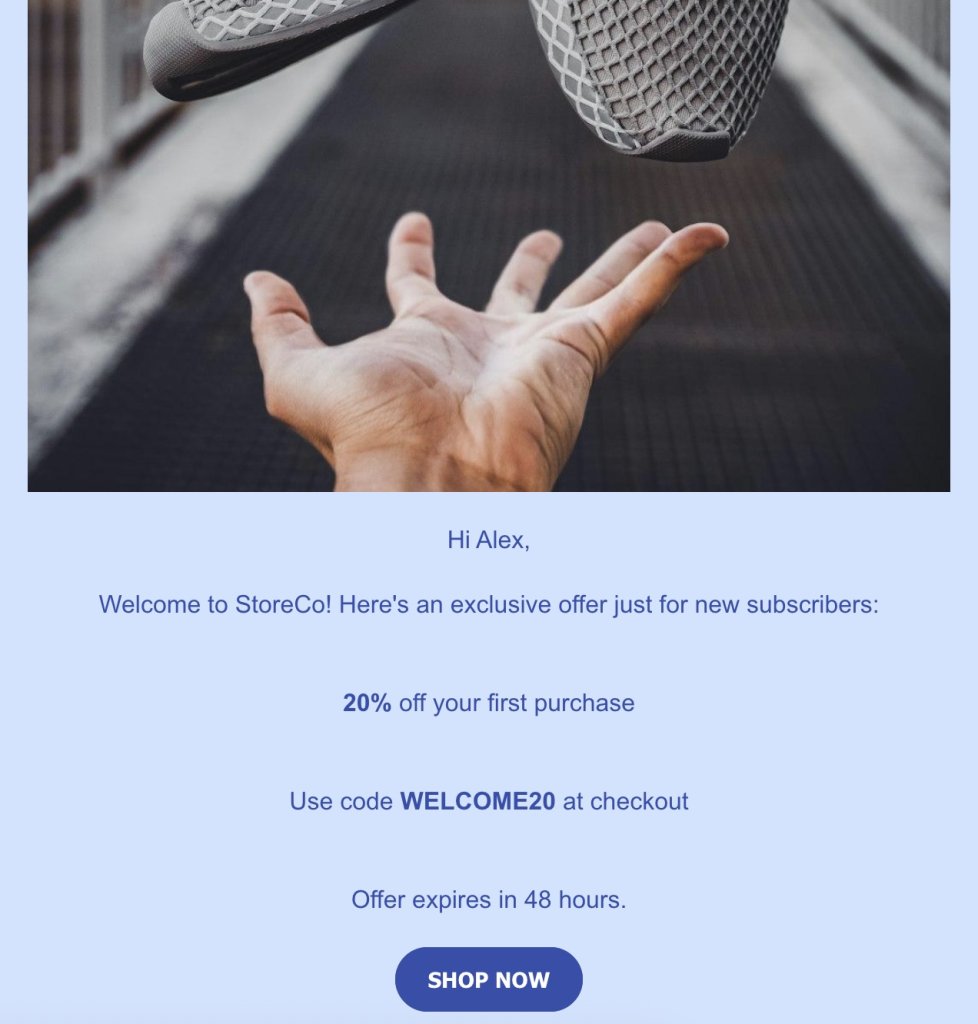
This email checks all three boxes: it targets a specific audience (new subscribers), personalizes the message with the recipient’s name and relevant offer, and includes a trackable code and button link to measure who clicks and converts.
Common email direct marketing examples include:
- Welcome emails after someone subscribes
- Abandoned cart reminders with discount codes
- Flash sales and time-sensitive promotions
- Product launch announcements
- Re-engagement email campaigns for inactive customers
- Birthday emails with personalized offers
Best for: Regular communication with your audience, sending time-sensitive offers, nurturing leads over time, staying in touch with past clients, sharing availability, following up with prospects, and reaching many people in a cost-effective way.
Skip if: You don’t have an email list yet, and no realistic way to build one organically through your website, content, or lead magnets. That said, don’t assume it’s impossible. There are plenty of creative ways to build your email list offline too, like collecting sign-ups at events, in-store, or wherever you connect with customers offline.
An email list is a collection of email addresses from people who gave you permission to contact them—they opted in through your website, signed up for updates, or subscribed to your content.
You build one by adding opt-in forms to your website, offering lead magnets (discount codes, free guides, exclusive content) in exchange for email addresses, or collecting emails at checkout. While it might seem tempting to shortcut this process by purchasing email lists, it simply doesn’t work and violates most email regulations.
Cost: Low—small lists (under 1,000 subscribers) typically cost $10-30/month, while larger lists (10,000+ subscribers) can run $100-300/month. Still budget-friendly compared to other channels, and costs scale with your audience size.
Email typically delivers 3000-4000% ROI, making it one of the highest-returning channels, though your actual results depend on your industry, list quality, and how well you write.
SiteGround Email Marketing makes this easy. It lets you manage campaigns, subscriber lists, and automation in one place without juggling separate tools or dealing with technical setup—particularly useful for small businesses getting started with email marketing. Plans start at just €2.40/month for 500 contacts, making it significantly more affordable than many email marketing platforms while still including all essential features.
Search & Display Advertising
When you need to catch people actively searching for what you sell—or stay visible after they leave your site—search and display advertising delivers. This includes pay-per-click (PPC) search ads that appear on search engines like Google and Bing, display ads (banner ads) across websites, and retargeting ads that follow visitors after they leave your site.
An online furniture store might run Google Ads targeting “modern office desks” to catch buyers actively searching, then use retargeting ads showing those exact desks to people who viewed them but didn’t purchase.
A B2B software company could run LinkedIn display ads targeting IT managers at companies with 50+ employees, driving them to a free trial landing page.
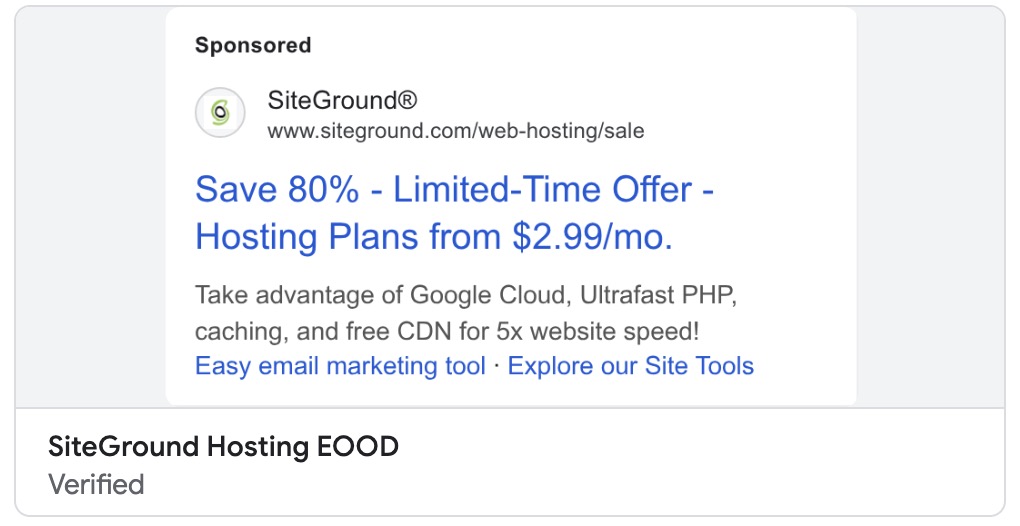
This Google search ad shows PPC advertising in action—targeting users actively searching for hosting with a time-sensitive offer.
Best for: Capturing high-intent buyers actively searching for solutions (PPC search ads), staying visible to people who’ve already shown interest but didn’t convert (retargeting), reaching specific professional audiences based on job titles or industries (display ads), scaling quickly once you know what converts.
Skip if: You don’t have budget for testing—paid ads require experimenting with different keywords, audiences, and creative before you find what works.
Also skip if your profit margins are too thin to absorb the cost per click (which can range from $1-50+ depending on competition), or if you lack landing pages optimized for conversions (sending paid traffic to your homepage wastes money).
Cost: Variable—search ads typically cost $1-5+ per click for most industries (legal and insurance can hit $50+), while display ads run $0.50-2 per click. Most platforms require minimum daily budgets of $10-20. Budget $500-1,000 monthly minimum to gather meaningful data and optimize campaigns.
Social Media Marketing
While search and display ads let you target people across the web, social media brings its own advantage—built-in audience data and native engagement tools that make targeting and interaction seamless. Social media direct marketing includes both direct messages (DMs) to individual users and targeted ads shown to specific audiences based on their demographics, interests, or behavior on the platform.
For instance, a fitness coach might run Instagram ads targeting women ages 25-40 who follow workout accounts, with a “Book your free consultation” button. Or a local bakery could send DMs to followers who commented on a recent post, offering a discount code.
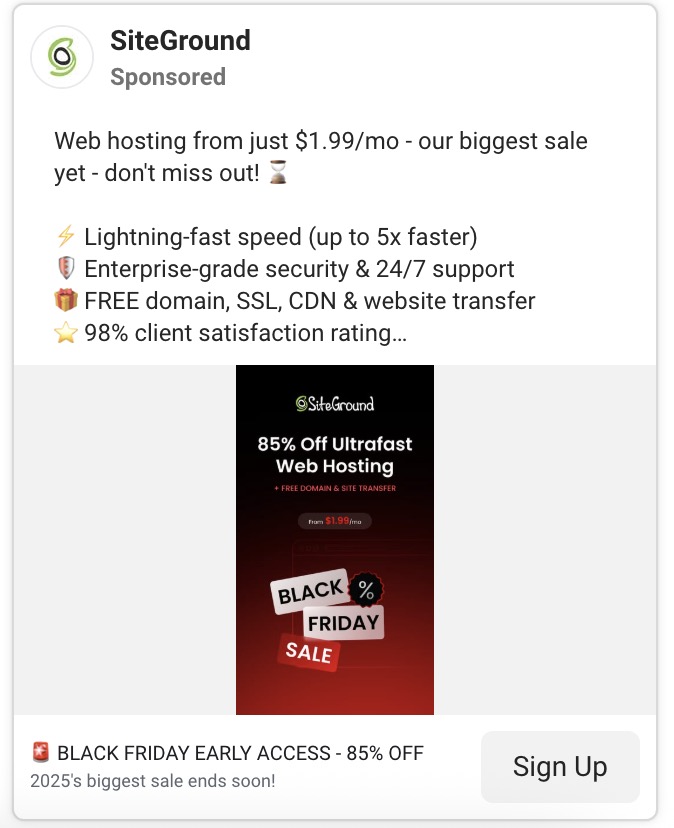
This ad targets specific audiences with a time-sensitive discount offer and a trackable “Sign Up” button—making it targeted, actionable, and measurable.
Common social media direct marketing examples include:
- Instagram Stories ads with “Shop Now” links
- Facebook retargeting ads to website visitors
- LinkedIn InMail campaigns to decision-makers
- Instagram DMs with personalized offers to engaged followers
- TikTok ads targeting specific age groups or interests
Best for: Building your audience without existing contact lists, targeting younger customers on social feeds, showcasing products, services, or portfolio work, engaging prospects through comments and DMs, combining brand awareness with direct sales, and retargeting website visitors. It’s less intrusive than cold calling and more scalable than direct mail.
Skip if: Your target audience isn’t active on social platforms—if you’re selling B2B software to executives or services for older demographics who don’t use social media platforms regularly, your money’s better spent elsewhere.
Cost: Variable—you can start with $5-10/day for ads and scale based on results.
Direct mail
Direct mail involves sending physical promotional materials—postcards, letters, brochures, or flyers—directly to prospects’ or customers’ mailboxes.
A local HVAC company might mail postcards offering seasonal maintenance specials to homeowners in their service area, or an ecommerce brand could send a personalized “We miss you” postcard with a discount code to customers who haven’t purchased in six months.
Common types of mail include:
- Postcards
- Sales letters
- Brochures and flyers
- Catalogs
- Coupons and vouchers
Best for: Local businesses targeting specific neighborhoods or zip codes, high-value offers where a physical piece stands out (real estate, home services, luxury products), reaching older demographics who engage more with physical mail, creating a tangible reminder that doesn’t get lost in digital noise.
Skip if: You’re operating on tight margins and can’t absorb printing and postage costs, your target audience is exclusively younger and digitally native, or you don’t have good address data for your target customers.
Cost: High—expect $0.50-2+ per piece including printing and postage, making it best suited for high-margin products or services.
Catalogs
Catalogs are technically a type of direct mail, but they deserve their own section because they work differently. They’ve been around since the 18th century, making them one of the oldest forms of direct marketing—and they still work today for the right businesses.
Unlike single-offer promotions like postcards, catalogs are comprehensive product showcases that require a different approach and bigger investment.
Today, businesses send printed or digital booklets featuring product listings with descriptions, photos, pricing, and ordering information directly to existing or potential customers.
A home goods company might mail a seasonal catalog showcasing new furniture collections with order forms and promo codes, while a specialty tool retailer could send a comprehensive catalog to contractors featuring hundreds of products organized by category.
Best for: Product-heavy businesses with diverse inventory, high-ticket items that benefit from detailed photos and descriptions (furniture, luxury goods, specialty equipment), reaching audiences who respond well to tangible materials, particularly for high-value or local offers.
Skip if: You have fewer than roughly 20 products (not enough to fill a catalog worth mailing), you sell purely digital offerings (software, courses, services), or your margins are too thin to cover printing and mailing costs.
Cost: Very high—printing multi-page catalogs plus postage can run $2-5+ per piece, making this viable only for businesses with strong margins and significant product ranges.
Tracking catalog ROI: Use unique promo codes for each mailing, dedicated phone numbers, QR codes linking to tracked landing pages, or personalized URLs. This lets you measure exactly which catalogs drive sales and calculate ROI per mailing.
Telemarketing
While digital channels dominate modern marketing, phone calls still close deals—especially high-value ones. Telemarketing is a form of direct marketing where businesses make phone calls to prospects or existing customers to promote products, schedule appointments, conduct surveys, or close sales.
A B2B software company might call qualified leads to book product demos, or a dental office could call patients due for checkups to schedule appointments.
Best for: B2B sales where deals require conversation and relationship building, high-value services that need explanation (insurance, financial planning, enterprise software), appointment setting for consultations or demos.
Skip if: You’re selling low-cost consumer products where the cost of a phone call outweighs the potential sale, or your target audience actively avoids phone calls (younger demographics typically prefer digital communication).
Cost: High—whether hiring reps or doing it yourself, factor in significant time investment per call, making it viable mainly for high-ticket sales.
Cold Calling
Cold calling is telemarketing’s harder-to-pull-off cousin—making unsolicited phone calls to prospects who haven’t expressed interest in your product or service yet.
A B2B software sales team might call companies that fit their ideal customer profile to introduce their solution and book a demo, or a commercial real estate agent could call business owners to discuss property opportunities.
Best for: Complex B2B sales that require conversation to explain value and handle objections, high-ticket services where building rapport matters (enterprise software, commercial services, financial products).
Skip if: You’re selling to consumers (most hate cold calls), your product is low-cost and self-explanatory (people can just buy it online), or your margins are too low to justify the time investment per call.
Cost: High—whether you’re making calls yourself or hiring reps, the time investment per conversion is significant, making this practical only for higher-value sales where the commission justifies the effort.
Text (SMS) Marketing
When your marketing message absolutely needs to be seen within minutes—not hours or days—SMS delivers. Text (SMS) direct marketing is when businesses send promotional messages, alerts, or updates directly to customers’ mobile phones via text message.
A restaurant might text “Tonight only! A free cocktail with each preset menu—show this text to your server to claim yours.” to subscribers, or a salon could send appointment reminders with a link to reschedule if needed.
Best for: Deals that need immediate response (flash sales, limited inventory alerts), appointment reminders to reduce no-shows, local businesses reaching customers in their area, updates that people need to see quickly (order confirmations, delivery notifications).
Skip if: You don’t have explicit opt-ins from customers—SMS direct marketing is heavily regulated, and sending texts without permission can result in serious fines and damage your reputation. Under TCPA, you need written consent before texting, and violations can cost $500-1,500 per unsolicited message.
Cost: Low to moderate—typically $0.01-0.05 per message, with most platforms charging monthly fees starting around $20-30 plus per-message costs.
Push Notifications
Unlike SMS, which requires phone numbers and costs per message, push notifications are free once someone opts in through your app or website. They’re clickable messages that appear on users’ mobile devices or desktop browsers, sent to subscribers who’ve given permission.
An ecommerce app might send “Your cart items are selling out—complete checkout now” when inventory drops, while a news site could push breaking stories to browser subscribers with a link to the full article. A fitness app could remind users “You haven’t logged a workout in 3 days—let’s get back on track.”
Best for: Re-engaging app users who’ve gone quiet; sending time-sensitive updates that need immediate attention (flash sales, breaking news, appointment reminders); driving users back to your app or website without needing their email or phone number; and delivering personalized content based on in-app behavior or preferences.
Skip if: You don’t have a mobile app or website with significant traffic—push notifications require users to opt in first, and if you’re just starting out, you won’t have enough subscribers to make this worthwhile. Also skip if your messages aren’t actually urgent; people who get irrelevant push notifications disable them fast.
Cost: Free after setup—no per-message fees like SMS. You’ll need push notification software (many are free for basic features, or $10-50/month for advanced targeting) and developer time to implement if you’re building from scratch. The main cost is the technical setup, not the ongoing sends.
Which Direct Marketing Channel Should You Choose?
You don’t need to be on every channel. You need to be on the right one for your business. Here’s how to decide where to start:
| If your business… | Start with… |
| Has an existing email list or can build one | Email marketing. It’s the highest ROI channel and you already have the audience. Focus on getting your first direct marketing campaign out and measuring results. |
| Needs revenue quickly (this week or month) | Text marketing or social ads. SMS can drive purchases within hours for impulse buys, while social ads typically convert within 1-7 days depending on your product. |
| Wants to capture people actively searching for your solution | Search advertising (Google Ads, Bing Ads). Target high-intent keywords people use when ready to buy. Combine with retargeting to follow up with visitors who didn’t convert. Budget $500-1,000/month minimum for testing. |
| Sells high-value or complex B2B services | Telemarketing or cold calling. High-ticket sales need conversation. Pick up the phone, build relationships, and book demos or consultations. |
| Targets customers in specific geographic areas | Direct mail or SMS. Mail a postcard to specific zip codes. Text people in your area with time-sensitive offers. Both work well for local businesses with geographic boundaries. |
| Targets younger, social-media-active audiences | Social media marketing. If your product photographs well (fashion, food, home decor, art), use Instagram or Facebook ads to show it off and drive clicks. Instagram works best for visual products and audiences under 40, while Facebook reaches older demographics and works well for local businesses. |
| Has a mobile app or high-traffic website with engaged users | Push notifications. Free to send after setup, great for bringing users back to your app or site without needing their contact info. |
The best approach? Pick one channel, give it enough time to gather real data, measure what’s working, and then decide whether to scale or pivot. Give email 3-4 weeks, social ads 2-3 weeks, direct mail 6-8 weeks, or telemarketing 1-2 months depending on your sales cycle. Don’t spread yourself thin trying to do everything at once.
When do you add a second channel? Once your first channel is consistently profitable for 2-3 months, consider adding a complementary one. Email + SMS work well together (same audience, different urgency levels). Social ads + email retargeting create a powerful combo. But don’t add channels just to add them—only expand when you’re maxing out your current channel’s potential.
Advantages and Disadvantages of Direct Marketing
Like any marketing strategy, direct marketing has clear benefits and real challenges. Here’s what you need to know before you commit budget and time.
Direct Marketing Advantages
Measurable results → You know exactly what’s working
You can track opens, clicks, and conversions down to the individual level. This gives you hard data to calculate ROI and cut what doesn’t perform.
Precise targeting → Stop wasting money on people who won’t buy
You reach people who’ve shown interest, match your customer profile, or have bought before—not everyone in a zip code or age bracket.
Personalization → Higher response rates than generic ads
When you reference past purchases or tailor offers to specific interests, people pay attention. Personalized messages consistently outperform generic ones.
Cost-effective → Start small, scale what works
Test with a small send. If it works, scale up. If it doesn’t, you’ve spent little to learn what not to do.
Speed → Launch campaigns in days, not months
Write an email today, send it tomorrow. When you need quick revenue or have time-sensitive offers, direct marketing moves fast.
Direct Marketing Disadvantages (And How to Avoid Them)
Can feel intrusive
Nobody wants spam, and reaching out to people who didn’t ask to hear from you damages your reputation and gets you ignored—or worse, reported and blocked.
→ Fix: Only contact people who explicitly opted in through sign-up forms or checkboxes.
Requires list management
Contacts change, addresses bounce, people unsubscribe.
→ Fix: Use tools that automate list cleaning and remove bad contacts automatically. Implement double opt-in to verify email addresses upfront—this means subscribers confirm their signup through a verification email, which filters out fake addresses and improves list quality from the start.
Privacy regulations
CAN-SPAM and GDPR carry serious fines if violated.
→ Fix: Include unsubscribe links, get explicit consent, and don’t buy or sell contact data.
Depends on data quality
Outdated emails or wrong phone numbers tank your results.
→ Fix: Verify contacts regularly and remove bounces immediately.
Risk of oversaturation
Too many messages and people tune out.
→ Fix: Set a schedule, stick to it, and make every message valuable.
Limited reach compared to mass marketing
You’re only reaching people on your lists or who match your targeting criteria—not entire markets. If you need broad brand awareness fast, traditional advertising reaches more people at once.
Your Direct Marketing Starting Point
Direct marketing works because it’s measurable, targeted, and scalable—you reach specific people, track results, and adjust based on data. The hardest part is just picking a channel.
If you’re unsure, start with email direct marketing. It’s low-cost, low-risk, delivers high ROI, and works for nearly every business type.
Your next step is simple: build your list (or clean up the one you have), send your first campaign, and measure what happens—track email marketing metrics like open rates, click-throughs, and conversions to see what’s actually driving results. Then do more of what works and drop what doesn’t.
And if you need a straightforward way to get started, SiteGround Email Marketing handles direct marketing campaigns, list management, and automation without the usual technical headaches—built for businesses that need results without complexity. If you’ve decided email marketing is your starting point, SiteGround gives you everything you need to take action.


Comments ( 0 )
Thanks! Your comment will be held for moderation and will be shortly published, if it is related to this blog article. Comments for support inquiries or issues will not be published, if you have such please report it through our official channels of communication.
Leave a comment
Thanks! Your comment will be held for moderation and will be shortly published, if it is related to this blog article. Comments for support inquiries or issues will not be published, if you have such please report it through our official channels of communication.