Marketing mix strategy for first-time sellers: maximum impact with minimum budget
Most small business owners start marketing by doing. They post on Instagram, run a quick ad, send an email to their list. Cross fingers; hope something sticks. It’s not a bad instinct. Taking action beats waiting for a perfect plan. But without a framework connecting all those moves, you end up scattered, second-guessing yourself, and spending time (and money) in the wrong places.
That’s exactly the problem the marketing mix was designed to solve.
The marketing mix is a structured way of thinking about how you bring your product or service to market. It helps you stop guessing and start making deliberate decisions, even when your budget is tight, your team is small (or nonexistent), and your time is limited.
In this guide, you’ll learn what the marketing mix is, how each element works, and, most importantly, how to actually apply it as someone starting out with real constraints. We’ll also cover how the framework has evolved from 4 Ps to 7 Ps, and when that distinction matters for you.
Key takeaways
- The marketing mix helps you stop guessing and build marketing that works as a system, not scattered tactics.
- Start with the 4 Ps of marketing — Product, Price, Place, and Promotion — before adding complexity.
- Prioritize owned marketing channels like your website and email list before investing in paid ads.
- Focus on one or two channels you can consistently maintain instead of trying to be everywhere.
- Test and refine continuously: sustainable growth comes from iteration, not one-time marketing campaigns.
- Move to the 7 Ps only as your business grows and customer experience becomes more complex.
What is the marketing mix?
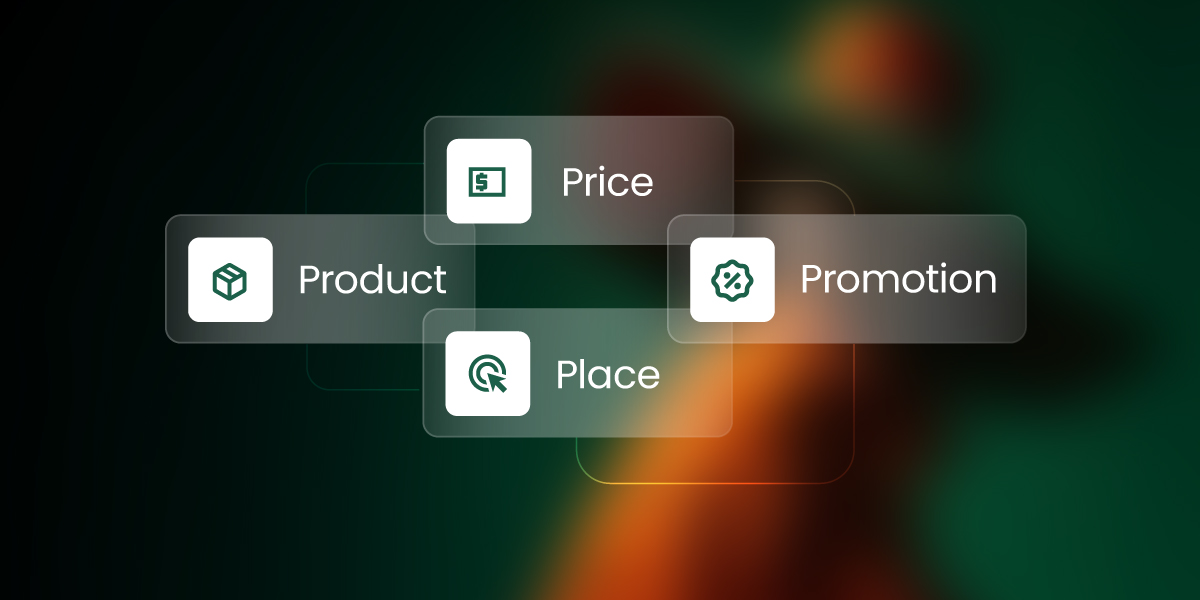
The marketing mix is a strategic framework that helps businesses make deliberate decisions about how to bring a product or service to market. It organizes marketing into four core elements — Product, Price, Place, and Promotion — so that every decision works together as a system rather than a set of disconnected tactics.
The concept was introduced by professor E. Jerome McCarthy in the 1960s, who organized marketing strategy into these four categories, now known as the 4 Ps of marketing. While the model has expanded over time, the original four remain the foundation every marketer — beginner or seasoned — should understand first.
For small businesses, defining the marketing mix is especially valuable because it forces clarity before spending. Rather than asking, “What should I post today?”, it asks, “What am I selling, to whom, at what price, and through which channel?” That shift in thinking can save you months of effort, never mind a lot of existential spiraling over your analytics dashboard. Once your mix is in place, it also becomes the foundation for more advanced approaches like growth marketing, but that’s a later chapter.
The 4 Ps of the marketing mix
The 4 Ps represent the pillars of basic marketing — understanding what you sell, who it’s for, where customers find you, and how you promote it. Before layering in more advanced concepts, every small business owner should have a clear answer to each of these four concepts. Think of them as the building blocks. Get these right, and everything else in your marketing becomes easier and more effective. So let’s unpack.
1. Product
Your product isn’t just what you sell. It’s the problem you solve and how you position that solution for a specific person. A product can be a physical item, a digital download, a service, or a subscription. What matters is that you can articulate what it does, who it’s for, and why it’s the right choice over the alternatives. Product clarity is the foundation of your entire mix. Get this fuzzy, and everything downstream suffers, including perhaps your will to keep going.
- The one-sentence test: Can you describe what you sell and who it’s for in a single sentence? If it comes out murky, your marketing will too. Your pricing will feel arbitrary, your promotion will feel generic, your brand will feel scattered, and your ideal customer won’t recognize themselves in your messaging.
- The differentiation question: What makes your product different from the next option your customer might choose? You don’t need a unique answer that no one else on earth can claim, but you do need a true and specific one.
In practice:
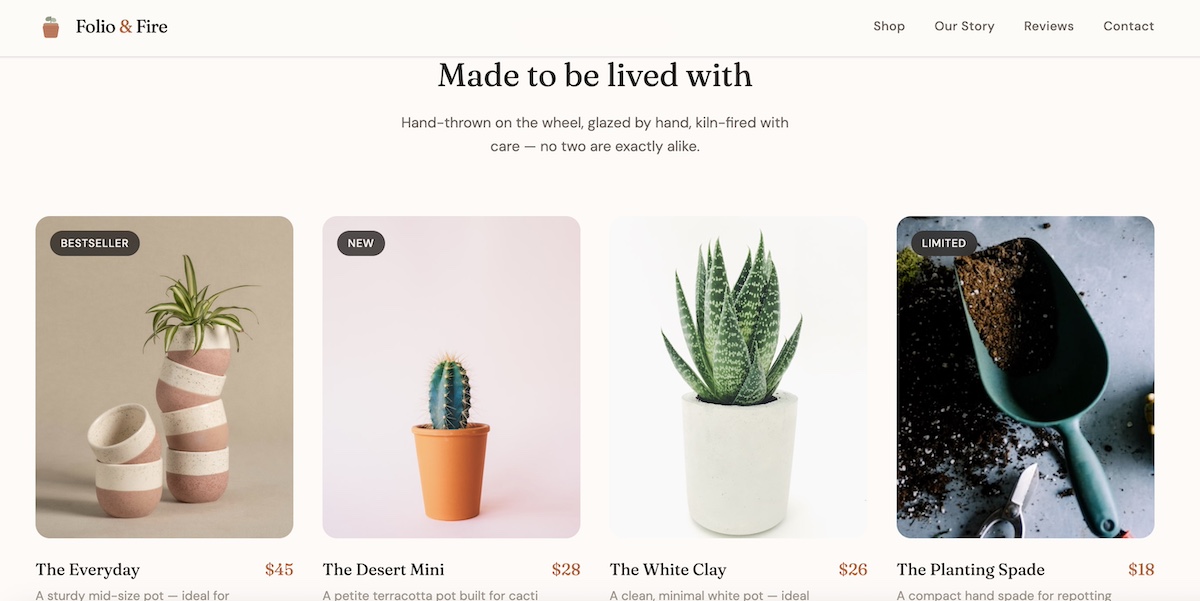
Nadia runs Folio & Fire, a small business selling hand-thrown ceramic planters and a companion digital guide called Roots: A Beginner’s Guide to Plant Care. When she first tried to write her Instagram bio, she couldn’t get it under four sentences. That was the signal. She went back to basics: “I make ceramic planters for plant lovers who want their home to feel intentional.” One sentence. Suddenly her website, product photos, welcome email, and packaging copy all had something to align to.

Like what you see? The Folio & Fire website was made in only ten minutes using SiteGround’s Coderick AI. Just a simple prompt and additional tweaking can turn out a beautiful site in no time.
2. Price
Price is in fact more than a number. It’s actually a signal. Decades of consumer research show that people often use price as a shortcut for judging expected quality — when something is priced higher, they tend to assume it will be better before they ever experience it. So before a customer reads your description or visits your product detail page, your price is already communicating something about the quality, exclusivity, and value of what you offer. Getting it right matters more than most beginners realize.
Common mistakes to avoid:
- Underpricing out of fear. Charging less than your product is worth might feel safe, but it attracts price-sensitive buyers, undercuts your margins, and makes your offer look less credible.
- Copying competitors without context. Competitor pricing reflects their costs, positioning, and target customers, none of which may apply to you.
How to validate pricing with limited data:
- Offer two or three pricing tiers and see where customers land
- Send survey emails and ask early buyers whether price was a factor in their decision
- Run a short A/B test on a landing page
For service providers and creators especially: raising your price often increases interest rather than reducing it, because a higher price can increase perceived value, implying expertise and seriousness that a low one undercuts.
In practice: Nadia launched her planters at $18 because she was nervous. They sold, but barely. A maker friend pointed out that similar planters at a local market were going for $55 and selling out. She also had to make peace with something else: yes, someone could find a planter on Amazon for $10. But that person was never her customer. Nadia wasn’t selling a planter — she was selling something handmade, considered, and worth displaying. Pricing like the $10 option only undermined that. Nadia ran a small test: she listed three new planters at $45 and emphasized the hand-thrown, local-business process in the description. They sold faster than the $18 ones ever had. Her digital guide followed the same logic: she’d been offering it as a free download, but when she priced it at $12, people started treating it like the resource it actually was.
3. Place
“Place” refers to where your target market finds you and where the transaction actually happens. In modern marketing, these touchpoints are often called distribution channels — the paths through which customers discover, evaluate, and buy from your business.
The central question isn’t “where should I be?” It’s “where does my customer already go, and can I meet them there?” For small businesses today, that typically means some combination of a website, email list, social platforms, and online marketplaces.
Owned vs. borrowed channels
- Owned: Your website, your email list. These belong to you and compound over time.
- Borrowed: Your Instagram following, your TikTok audience. These live on someone else’s online platform, and are subject to algorithm changes, policy updates, and outages you can’t control. Social media marketing matters, but it’s important to keep in mind that it can be unpredictable.
It’s worth noting that organic reach on platforms like Instagram can be in the single digits as a percentage of your followers, which means most people who chose to follow you never see your content in their feed anyway.
Building an email list, on the other hand, is building an asset. Growing a follower count on a platform you don’t own is renting space, and the landlord can change the rules at any time. Grow your own email list? That makes you the landlord.
When you can’t be everywhere (which is most small businesses), prioritize the marketing channels where your target audience is most active and where you have the most control. Turns out, being really present in two places beats being kind of present in five. A strong website and a growing email list are your top go-tos.
In practice: Nadia was spread across Instagram, Pinterest, Etsy, and a website she’d barely touched. Nothing felt consistent and she was exhausted keeping up with all of it. She made a call: Instagram marketing for discovery, her own website for purchasing, and an email list for everything else. She stopped posting on Pinterest entirely. Within two months, her website traffic was up and she had 200 people on her list — people she actually owned access to, regardless of what any algorithm decided to do next.
Did you know?
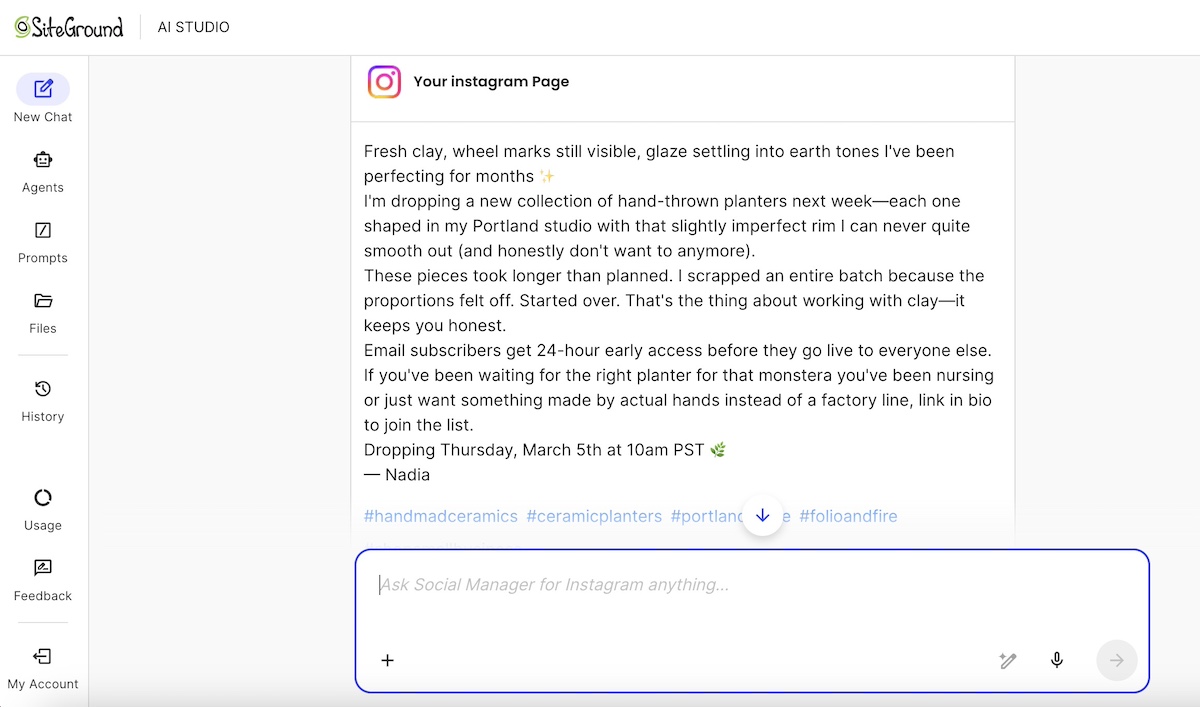
As a SiteGround client, you already have access to marketing tools available in AI Studio — and for small businesses trying to do more with less, it’s worth exploring. With the Plus plan, you unlock 15+ specialized agents that can handle a surprising amount of the marketing work on this list: a social media manager that publishes directly to your connected profiles, an email marketing agent that builds campaigns and exports them straight to SiteGround Email Marketing, and an AI image designer for banners, social posts, and more. It’s the kind of output that used to require a whole team, but now it’s manageable for a team of one.
4. Promotion
Promotion is how you communicate your offer to the right people at the right time. It’s the part of the marketing mix most people jump to first, but it works best when the other three Ps of marketing are already solid. A great sales promotion strategy can’t rescue a vague product, a wrong price, or the wrong channel.
Main promotion channels for small businesses:
- Organic social media: low cost, slow build, algorithm-dependent
- Content marketing and SEO: slow to start, compounds well over time
- Paid advertising: fast results, but requires budget and ongoing spend
- Partnerships and referrals: high trust, often underused by beginners
- Email marketing: owned audience, high ROI, works at every stage
Why email deserves a featured spot here: Unlike social, email reaches people who already opted in to hear from you. Unlike paid ads, it doesn’t stop working the moment you stop spending. Unlike SEO, it can produce results relatively quickly even with a modest list. Plus, it consistently delivers some of the highest ROI of any marketing channel, which makes it a natural starting point when budget is limited.
This highlights an important distinction in marketing: understanding which distribution channels generate sustainable organic traffic versus where paid investment makes sense.
Free vs. paid — a realistic breakdown:
- Free/near-free traffic to your website: Organic social, content, SEO, email marketing
- Worth paying for once you have traction: Paid ads to amplify what’s already working organically, not as a substitute for building owned channels first
In practice: Nadia’s first promotion instinct was to run Facebook ads. Instead, she started a simple monthly email: new planter drops, a care tip for whatever plant was in season, and a link to her digital guide. It took 30 minutes to write and cost nothing. By the time she did try paid ads — six months later, with a real list and a converting website — she already knew what messaging worked, because her email subscribers had told her.

Tools like SiteGround Email Marketing make it straightforward to get started with email campaigns like the one above. Build your list, design campaigns, amply your marketing communications, and track performance without needing a dedicated marketing team or a large budget.
Start sending emails now>>
From 4 Ps to 7 Ps: when does it matter?
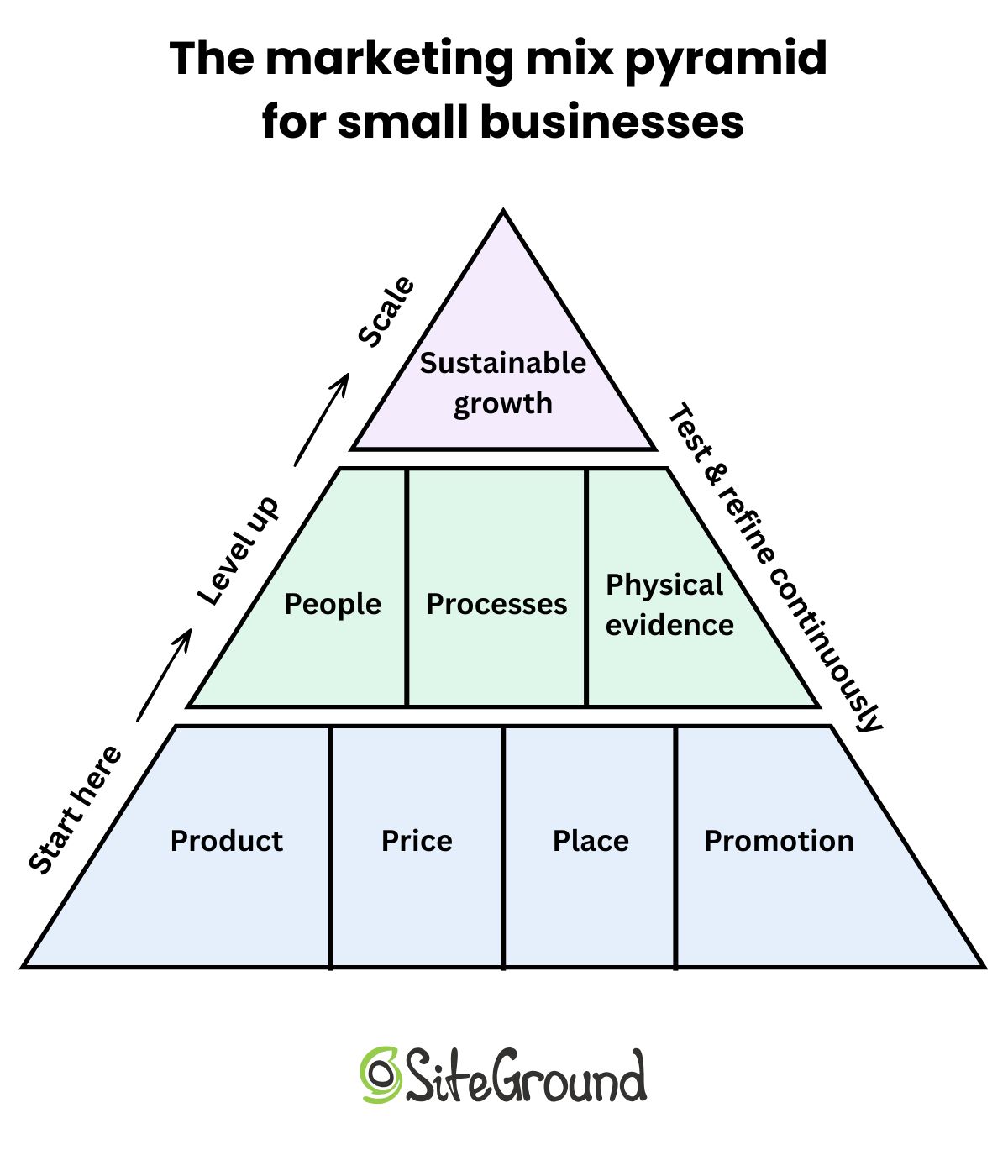
The 7 Ps are an extended marketing mix, building on the original framework by adding three more elements: People, Process, and Physical Evidence (sometimes called Packaging). These additions came out of the services marketing world, where the customer experience itself is part of the product. That said, they’re increasingly relevant to any business that has repeat customers and wants to grow.
- People refers to the human side of your brand. We’re talking about your team, your customer service, and the way anyone who represents your business interacts with customers. For a solo creator or one-person shop, “people” is largely you. Your responsiveness, your tone, and your follow-through all shape how customers feel about buying from you.
- Process is how customers experience doing business with you. This includes the entire customer journey, from how easy it is to buy, to how you onboard a new client, to how you handle fulfillment and follow-up. A smooth process reduces friction and increases repeat purchases. A clunky one creates frustration even when the product itself is great.
- Physical Evidence (or Packaging) covers how your brand looks and feels across every touchpoint — your website, your packaging, your email templates, your invoices. Consistency here builds trust and makes your brand feel more established, even if you’re a team of one.

In practice: This on-brand packaging image for Folio & Fire was made in minutes using the SiteGround AI Studio Image Agent. With a quick prompt, marketing and packaging dreams come to life.
For beginners, the 7 Ps are best understood as a “level up” rather than a starting requirement. Get the 4 Ps working first. Build your offer clarity, price with intention, show up in the right place, and promote consistently. Then revisit the additional three Ps as your business grows and the customer experience becomes a more complex thing to manage.
How to build your own marketing mix on a small budget
Knowing the framework is one thing, but, alas, using it is another. Here’s a practical sequence for building your own marketing mix when you’re working with limited time and money.
Step 1: Audit what you already have. Before adding anything new, take stock of what exists. Can you describe your offer clearly? Do you have a website? An email list, even a small one? A social presence? Existing customers you could ask for feedback? Most beginners have more to work with than they realize — the audit just makes it visible.
Step 2: Identify your one primary promotion channel. Trying to be active on five channels at once is a reliable path to burnout and mediocre results everywhere. Pick the one channel where your target audience is most active and where you can show up consistently. That’s your primary channel for now. Everything else is secondary.
Step 3: Start with owned channels before investing in paid. Your email list and your website are assets that compound over time. Social media followings and paid ad audiences are not. Build the owned foundation first (get people onto your list, plan your website) before pouring money into channels that stop working the moment you stop paying.
Step 4: Test one thing at a time. The marketing mix is a framework for iteration and not a one-time marketing plan. Change one variable at a time (your pricing strategy, your messaging, your call to action) so you can actually learn what made a difference. Testing everything at once makes it impossible to know what worked.
| Focus Now | Layer In Later |
| Offer clarity and positioning | Paid advertising |
| Website that converts | Partnership and affiliate programs |
| Email list building | Advanced SEO checklist and content |
| One primary social channel | Multiple platforms and formats |
| Pricing validation | Tiered products and upsells |
Common marketing mix mistakes first-timers make
Most marketing mistakes don’t happen because you chose the wrong tactic. They happen because fundamentals get neglected. Here’s a rundown of the common marketing mix mistakes to avoid:
- Skipping product clarity and jumping straight to promotion is the most common. If you don’t know precisely what you’re selling and who it’s for, no amount of posting or advertising will fix it. All it does is amplify the confusion.
- Pricing based on fear rather than value keeps a lot of small businesses stuck. Underpricing doesn’t end up coming off as humility. Instead, it’s a positioning problem that attracts the wrong customers and makes sustainable growth harder.
- Spreading too thin across channels is the natural result of trying to do everything at once. You end up with a mediocre presence in five places instead of a strong one in the right one.
- Treating sales promotion as the whole marketing strategy means neglecting product, price, and place. This is like trying to sell a house by putting up a good sign and without first checking if the plumbing even works.
- Ignoring email in favor of social is one of the costlier long-term mistakes. Social platforms can change their algorithms or terms of service any time they fancy. Your email list, on the other, belongs only to you. Building on rented land has real risk.
- Not revisiting the mix as the business evolves turns a living framework into a dusty document. Your marketing mix should change as your offer matures, your customer base grows, and your budget expands. Schedule a quarterly check-in with yourself to ask whether the mix still fits.
Your marketing mix is the strategy — start here
You started this article posting on Instagram, running a quick ad, and crossing fingers. You’re leaving it with an actual framework — and that’s not nothing. Most people skip the marketing strategy entirely, go straight to tactics, and spend the next six months wondering why nothing compounds.
So start with the basics: get clear on your product, pressure-test your pricing strategy, pick two or three channels and own them. Once those are solid, promotion gets easier and cheaper because you’re no longer paying to send the right message to the wrong person in the wrong place.
At that stage, owned channels matter most, and email is often the first one that truly compounds. It gives you direct access to people who already chose to hear from you, without relying on algorithms or ongoing ad spend. SiteGround Email Marketing is built for exactly this moment: when your marketing strategy is clear and you’re ready to turn attention into lasting relationships.
Then, when you’re ready to scale without hiring, AI Studio is how you multiply what you’ve built — agents that handle the execution while you stay focused on the bigger picture. The framework gave you the strategy. Now go build something.
Marketing mix FAQs
The 4 Ps (Product, Price, Place, Promotion) are the original framework and the right starting point for most small businesses. The 7 Ps add People, Process, and Physical Evidence, which are elements that become more relevant as your business grows and the customer experience becomes more complex to manage. Start with 4. Revisit the additional 3 when your operations and team have grown enough that they matter.
Your marketing strategy is the big picture, such as your goals, your target market, your competitive positioning, and the direction you’re heading. Your marketing mix is the operational layer beneath that strategy, including the specific decisions about product, price, place, and promotion that bring the strategy to life. Think of the marketing strategy as where you’re going and the mix as how you’re getting there.
Small businesses use the marketing mix as a decision-making framework — a way to think through each element of their offer before committing time or budget to any tactic. In practice, this means auditing your offer clarity, validating your pricing strategy, choosing the right channels for your target market, and selecting promotion methods that fit your budget and goals. It’s a tool for prioritization as much as planning.
The 4 Ps translate directly to digital: your product is your offer and how it’s positioned online; your price includes any free tiers, trials, or dynamic pricing; your place is your website, email list, and the platforms where your target market finds you; and your promotion includes SEO, content, email, social media, and paid advertising. The digital environment gives you more ways to test and iterate each P quickly and affordably.
Start by auditing what you already have (your offer, your existing channels, and your current pricing). Then choose one primary promotion channel and focus on building owned assets (your email list and website) before spending on paid channels. Test one variable at a time so you know what’s actually driving results. The marketing mix doesn’t require a big budget, but it requires clear thinking and consistent execution. If you want to multiply your output on a limited budget, SiteGround AI Studio is a great place to start.
A quarterly review is a reasonable cadence for most small businesses. Your mix should evolve as your offer matures, your customer base grows, and your budget changes. If something in your marketing stops working (such as conversion rates drop, a channel goes quiet, pricing starts to feel off) that’s a signal to revisit sooner rather than waiting for the next scheduled check-in.





Comments ( 0 )
Thanks! Your comment will be held for moderation and will be shortly published, if it is related to this blog article. Comments for support inquiries or issues will not be published, if you have such please report it through our official channels of communication.
Leave a comment
Thanks! Your comment will be held for moderation and will be shortly published, if it is related to this blog article. Comments for support inquiries or issues will not be published, if you have such please report it through our official channels of communication.