ChatGPT ads are here: How AI tools help small businesses compete
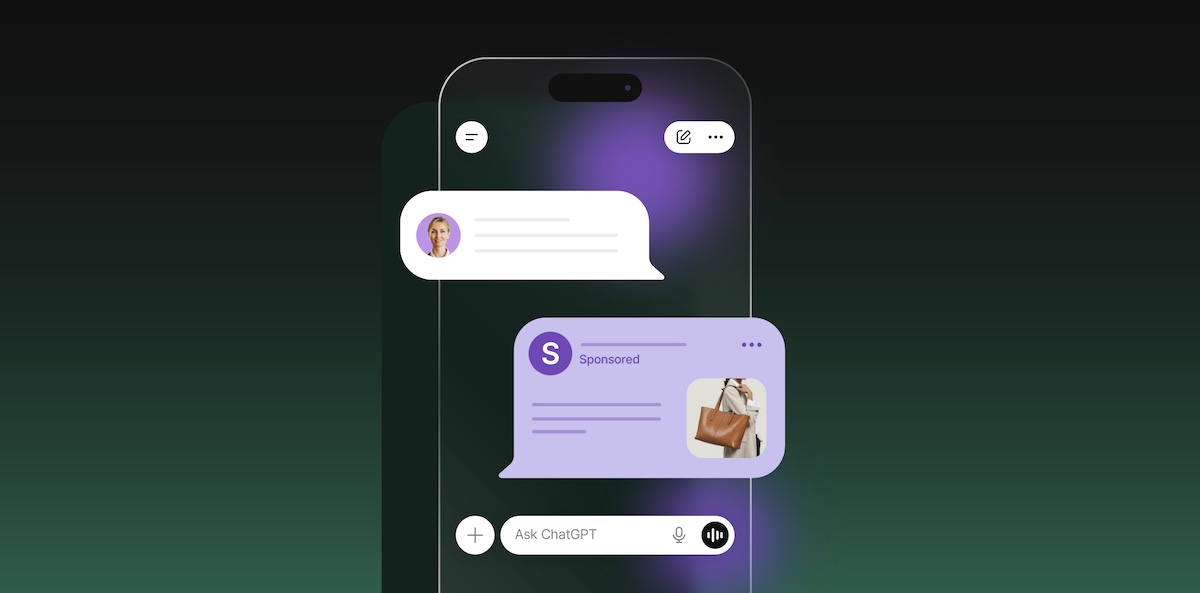
OpenAI recently announced that ChatGPT ads are rolling out soon. Cue the panic at the thought of competitors with marketing budgets the size of your annual revenue suddenly appearing in AI answers.
If you’re worried that these paid placements will push your business out of view, you are not wrong. But here’s a small-but-impactful secret: there is one type of visibility money cannot buy and it is exactly where small businesses have the edge.
With the right AI tools and strategy, you can show up organically in the AI recommendations your customers actually see, often faster and more efficiently than larger competitors tied up in approvals and budgets.
This guide walks you through how to build that organic AI visibility before ChatGPT ads start dominating the conversation. No massive ad spend required, just smart moves and the right tools.
Key takeaways:
- ChatGPT ads change the game. Paid placements may dominate AI answers, but organic visibility can’t be bought.
- Audit before you act. Understand how AI currently sees and mentions your business to identify gaps.
- Create content AI references. Build comprehensive, helpful content that directly answers customer questions.
- Manage reputation strategically. Reviews and online signals affect whether AI confidently recommends your business.
- Leverage AI tools. Specialized AI agents let small teams scale content, reputation, and cross-platform presence efficiently.
What ChatGPT ads are and how they work
ChatGPT ads appear as sponsored recommendations directly within AI conversations. For example, when a user asks “What’s the best CRM for small businesses?” they may see ChatGPT’s answer followed by a labeled “Sponsored” suggestion, matched to the topic for relevance.
The critical difference from Google Ads is how placement shapes perception. In traditional search, paid ads appear at the top, followed by organic results below. Users can scroll past ads to see organic rankings.
In ChatGPT, users receive one conversational answer that feels complete and authoritative. While sponsored content appears separately below that answer rather than replacing it, the conversational format impacts perception and consideration.
Why ChatGPT ads change everything for small business
The implications for small- and medium-sized businesses (SMBs) are significant. In a conversational interface, customers often rely on the first answer they receive. If your business isn’t included in that response, you may never enter the decision set at all.
Worse, AI recommendations feel authoritative and objective, even when they’re paid placements. And pricing will likely mirror Google Ads, meaning enterprise budgets will dominate competitive keywords. AI is completely changing marketing as we know it.
But here’s your small business marketing advantage: Organic AI visibility can’t be bought. It’s built by creating helpful, conversational content that AI naturally wants to reference. And AI tools let you do this at enterprise scale, creating optimized content and maintaining cross-platform presence without an entire marketing department. While big competitors debate strategy in committee meetings, you can implement changes in hours, not months.
Skip ChatGPT ads: 4 steps to build organic AI visibility instead
Now we’re all on the same page: you don’t need a massive budget to show up in AI responses. But you do need a systematic approach to building that organic visibility. And, you do need a plan. So here are your steps to build that much-coveted organic AI visibility.
Step 1: Audit your AI visibility
The problem
Most SMB owners have no idea if ChatGPT is recommending their business, sending customers to competitors, or giving generic advice that mentions exactly no one. Indeed, you might be invisible in the precise conversations where your ideal customers are asking for help, all while losing deals to competitors who aren’t actually better, just more visible to AI.
And once ads in ChatGPT are fully launched? Forget about it. Those same competitors will pay to appear first in conversations where you’re currently invisible. Without auditing your AI visibility, though, you won’t know what organic ground you’re losing or which questions to own before they become paid placements you can’t afford. Let’s fix that with AI tools that give you an edge.
The strategy: Do an AI visibility audit
To properly audit your AI visibility, you need to take a look at two perspectives:
- How AI can interpret your site
- How AI actually talks about your business in the wild
That requires two complementary tools:
1. Your technical foundation: SEO AI agent
An SEO AI agent, such as the SEO Expert from SiteGround, serves as your internal diagnostic system. By analyzing your key webpages one by one, it evaluates the critical on-page factors that influence how search engines and AI interpret your content, from content quality and website structure to technical best practices like improving page speed. It can also analyze your content against search intent and competitor performance, then provide a prioritized roadmap of improvements ranked by impact. This step tells you whether AI can understand and confidently surface your business.
SiteGround AI Studio is available to all SiteGround customers. You can start with the free AI Agent for WordPress (which supports SEO optimizations if you’re using WordPress) or upgrade to the Plus Plan to unlock a full suite of specialized agents, including the SEO Agent, along with tools for copywriting, reputation management, social posting, and more. It’s like expanding your team’s capacity and boosting productivity without hiring additional staff.
Explore your AI Studio now>>
2. Your reality check: LLM testing
Large language models (LLMs) like ChatGPT, Claude, Perplexity, and Gemini are where your customers are already asking questions (and are more so every day). They’re also where you can test your actual AI visibility in real time. We can go straight into the belly of the beast, leveraging it to reverse engineer how and when you can get mentioned.
Action steps: Connect the dots
Let’s bring both these tools together.
1. Review your technical foundation: Use the SEO AI agent to assess the core factors like page load speed, heading structure, internal linking, and metadata. These fundamentals matter for both Google and AI. If search engines struggle to understand your site, AI will too. You can simply start by asking it to do an SEO audit of your website, then drill down deeper as you see fit.
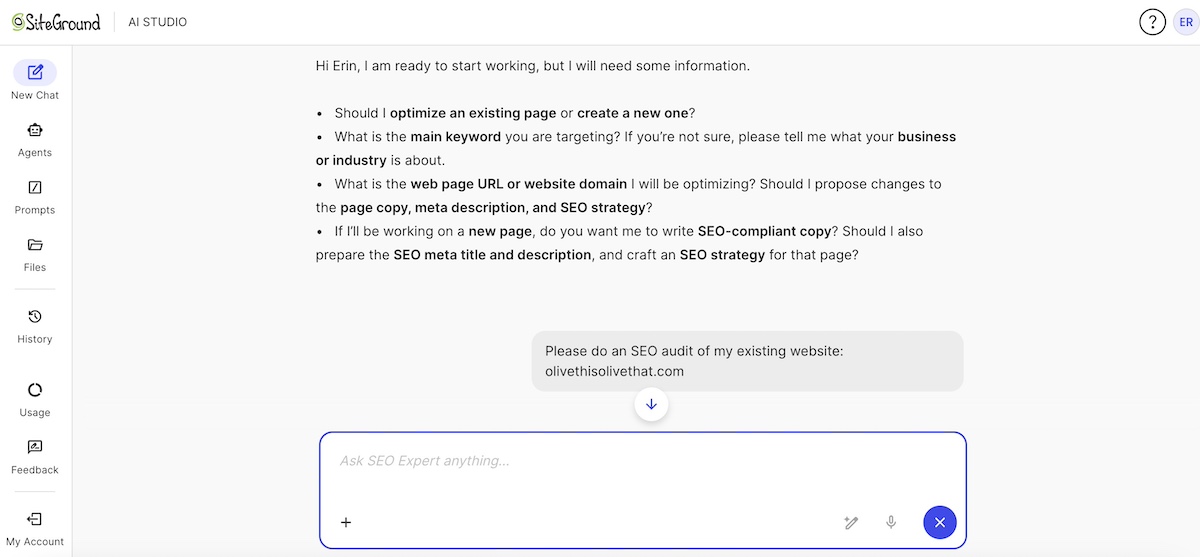
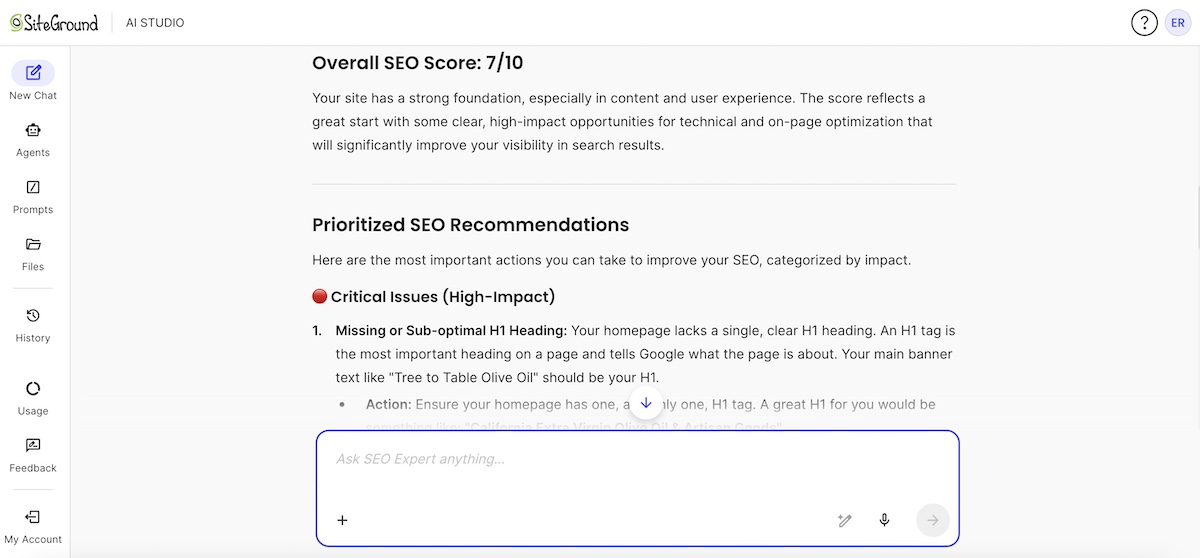
2. Evaluate content comprehensiveness: Does your site thoroughly explain your services, address common customer questions, and clearly communicate your differentiators? The SEO AI agent can identify content gaps where crucial information is missing.
3. Test and document AI responses
Open ChatGPT, Claude, Perplexity, or Gemini and ask:
- “What are the best [your solution] for [specific customer problem]?”
- Use the exact language your customers use. Be specific — instead of “best marketing agencies,” try “best B2B SaaS marketing agencies for companies under $5M in revenue.”
Then evaluate:
- Are you mentioned at all?
- Are competitors recommended instead?
- Is the AI giving generic advice without naming specific businesses?
- If competitors are recommended, ask: “Why did you recommend them?”
Track your findings in a simple spreadsheet: queries tested, whether you appeared, which competitors showed up, and what differentiators AI highlighted.
4. Cross-reference findings: If ChatGPT doesn’t mention your key differentiator and the SEO AI agent flagged that content as weak or thin, you’ve identified a priority fix. This is where your audit will turn into action. Take note.
SMB advantage
Your small-business agility is your superpower here. Once you identify gaps, you can implement changes immediately with no 47-person, corporate approval chain required. Lean into your advantage.
Step 2: Create content AI will reference
The problem
SMB owners like you are stuck in a content creation catch-22: You need comprehensive, helpful content that answers every variation of customer questions in your space, but creating said content manually (or even with the help of the average LLM) can mean months of work and know-how. You need the content depth of an enterprise blog with a team of two. That math doesn’t work without help.
And with ChatGPT ads as the latest digital marketing trend, the window for building organic content authority is getting smaller every day. Once those paid placements dominate AI responses, organic visibility and generative engine optimization — the practice of structuring content so AI systems naturally reference it — become even more critical, because it’s the only battlefield where budget doesn’t determine the winner.
The strategy: Leverage a specialized execution engine
Yes, any LLM can produce copy. But the quality depends entirely on your AI prompting acumen. A specialized copywriter AI agent, on the other hand, eliminates that burden. Instead of requiring you to specify every last SEO detail and structural element, a dedicated copywriting agent is already an expert. It bridges the gap between your raw audit takeaways (from Step 1) and dialed, performance-driven content. Now your optimized workflow becomes clear.
The SiteGround AI Studio Copywriter Agent has SEO built in. It automatically structures content with clear headings, integrates target keywords naturally, generates optimized titles and meta descriptions, and creates engaging, readable copy that keeps users on the page longer. It also guides readers with clear calls-to-action, helping turn traffic into conversions. All of this ensures your content is not just written, but designed to perform in both search engines and AI recommendations.
As a SiteGround customer, you can access AI Studio for free, or upgrade to the Plus plan to unlock the Copywriter Agent and the full suite of specialized AI agents.
Action plan: From gaps to authority
1. Turn audit insights into a content roadmap
Start with the missing questions, weak differentiators, and competitor strengths you documented in Step 1. This becomes your content topic roadmap.
2. Identify content type for each gap
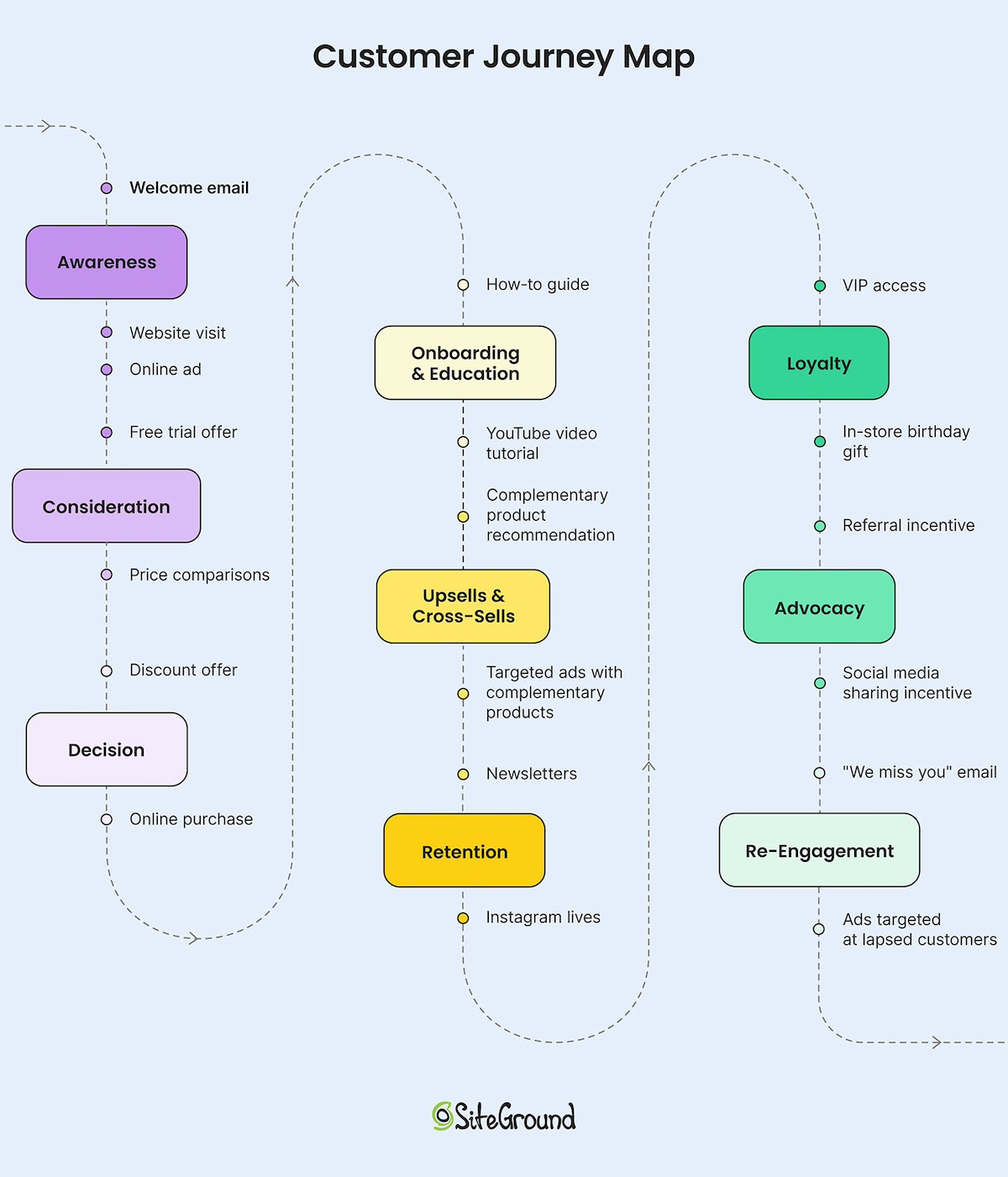
Based on your gaps, as well as the customer journey, decide the format that best addresses each gap:
- FAQ-style pages – Answer specific customer questions.
- How-to guides / problem-solving content – Help customers make decisions, troubleshoot issues, or understand options.
- Comparison / alternative pages – “[Competitor] vs. [Your Solution]” or “Best [solution] for [use case]” to capture high-intent queries.
- Expanded landing or service pages – Fill gaps where existing core offerings have thin coverage.
- General page updates – You may wish to update existing pages if the missing content fits naturally and the page already ranks for related queries. But plan to create new pages for unique, high-intent questions or topics that need structured formats (FAQs, guides, or comparison pages).
3. Feed a focused brief to the copywriter AI agent
Now that you know the topic and content type, submit a structured brief that includes:
- Customer question or missing topic
- Content type (FAQ, guide, comparison, landing page) and length
- Specific information AI failed to mention about your business
- Competitor positioning to address
- Key info about your brand
The AI agent transforms these briefs into SEO-optimized content.
4. Strengthen, optimize, and publish consistently
- Add specific examples, expert quotes, customer insights, and unique knowledge to differentiate your content (AI loves this).
- Ensure each piece uses clear headings, answers questions directly in complete sentences, and reinforces your differentiators.
- Maintain momentum. If you have a blog, publish two to four in-depth pieces per month to build authority. This kind of fresh, comprehensive content signals that you’re an active and reliable source, which is something AI systems increasingly reward.
SMB advantage
We already know AI can handle the heavy lifting of content creation. What matters now is using the right AI tools to create truly optimized content that helps your business surface in AI search. That visibility allows you to compete with enterprise advertiser content teams at a fraction of the cost. While large companies need layers of approval for every article, you can publish within days of identifying a content gap.
Step 3: Build and manage your reputation
The problem
There’s a key difference between traditional SEO search and AI-driven search. Google ranks based on technical factors and content quality, but AI tools act more like advisors than information organizers. That makes them far more cautious in their recommendations.
So if you have a few unresolved negative reviews? AI may skip mentioning you entirely, even if your content is excellent. Mixed sentiment across platforms? AI hedges or recommends safer alternatives. No reviews or mentions at all? You’re effectively invisible. Without clear trust signals, AI has nothing to base its recommendations on.
The challenge is compounded because reputation signals are scattered across platforms you barely have time to monitor, let alone manage strategically. Manual tracking is labor-intensive and most SMB owners simply don’t have hours to devote to it. Understandable.
The strategy: Systematic reputation management
To gain AI confidence, you need a reputation management system that:
- Reviews mentions and reviews across platforms.
- Analyzes sentiment patterns and identifies recurring issues.
- Prioritizes actions that will most impact perception and AI recommendations.
A reputation management AI agent serves as your operational backbone. It can scan review sites, social media, forums, and other customer feedback channels, then deliver a prioritized set of action items. This means you can focus on fixes that truly affect visibility, rather than chasing every minor mention in the hidden corners of the internet.
Action steps: Audit, prioritize, improve
- Run a comprehensive reputation analysis: Let the agent scan for your business mentions. Get the full picture of what customers are saying and where your strengths and weaknesses lie.
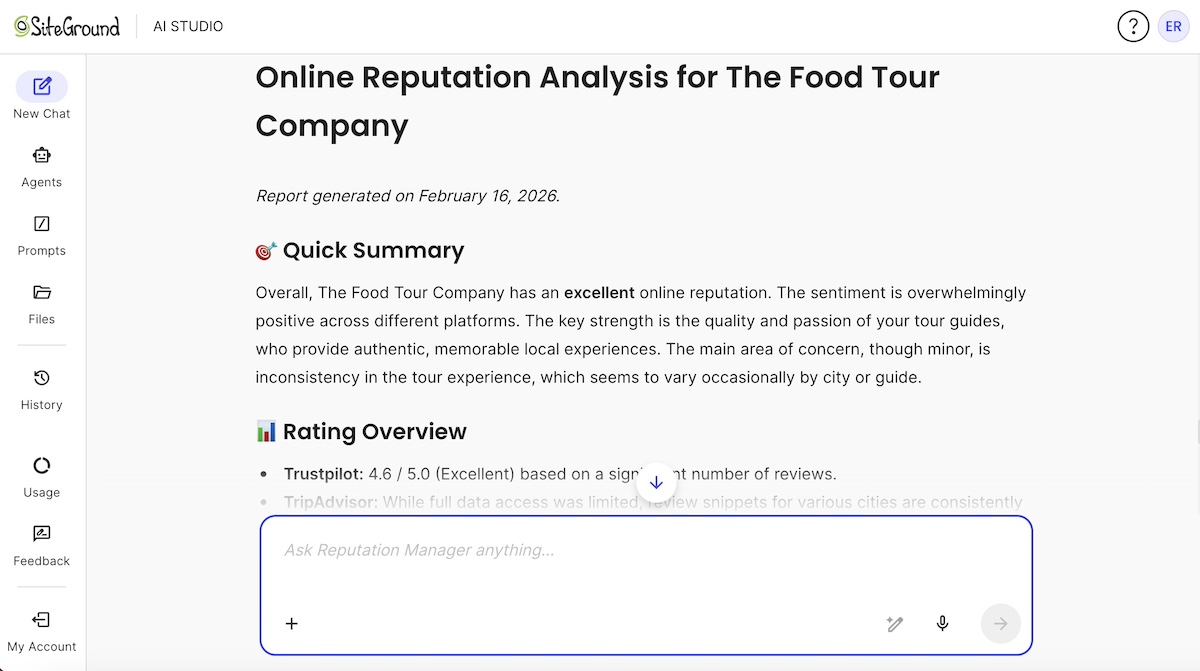
- Review sentiment patterns: Identify overall trends: positive, negative, or neutral. Break it down by platform and topic to see where AI may view your brand as trustworthy — or not.
- Prioritize and address critical issues: Not every negative review needs immediate action. Focus on those that impact customer perception and AI recommendation confidence. Respond to criticism professionally and constructively to show both humans and AI that you take feedback seriously.
- Encourage positive reviews: Make it easy for satisfied customers to share experiences across key platforms like Google Business Profile, industry-specific sites, and social media. Integrate this into post-purchase workflows using email marketing or other engagement tools. You can also gather feedback directly through survey emails in order to boost overall customer satisfaction.
- Implement and track improvements over time: Work through the agent’s action items methodically, fixing root causes rather than just managing symptoms. Run regular analyses monthly or quarterly to measure progress, monitor trends, and maintain momentum. AI rewards consistent improvement.
SMB advantage
As a small business, you have the benefit of authenticity, and that means it’s easier to generate positive reviews and build user trust, both with customers and AI. Enterprise companies often struggle to replicate this. So remember: your agility and personal touch are powerful advantages in building a reputation that AI confidently references.
Step 4: Maintain consistent cross-platform presence
The problem
ChatGPT doesn’t just pull from your website; it aggregates signals from the full web, such as social media, your Google Business Profile, reviews, and anywhere your brand appears. The challenge for you as a small business is twofold: you need both broad visibility and consistent messaging. Without both, AI can’t confidently recommend your business.
Even with a wide presence, inconsistency creates doubt. If your website says you specialize in sustainable packaging, your Instagram bio says eco-friendly solutions, and your LinkedIn highlights green business practices, AI struggles to describe you clearly. Mixed messaging signals uncertainty.
Maintenance gaps matter too. An inactive Facebook page or mismatched business hours between platforms signals neglect. AI notices these gaps and interprets them as lower credibility.
But alas, for small businesses, maintaining an active, consistent presence across five or more platforms while running day-to-day operations is difficult. Most focus on one or two channels and let the rest go stale. And AI notices.
The strategy: Cross-platform consistency
To be confidently recommended by AI, you need a unified approach to messaging and platform activity:
- Centralized messaging framework: Every platform should communicate the same core value proposition, differentiators, and business details.
- Platform-specific optimization: Content should be customized to each channel’s format and audience expectations without breaking your messaging consistency.
- Ongoing engagement: Regular posting and interaction signal both human responsiveness and brand activity, which AI values highly.
Action steps: Implement and monitor
- Define core messaging: Use a specialized copywriter AI agent to clarify who you serve, your differentiators, your unique selling proposition, and the problems you solve. Document this in a simple brand brief; this becomes your consistency anchor.
- Standardize essential business information: Ensure your business name, services, hours, contact details, and key differentiators appear identically across all platforms. Update everything simultaneously whenever changes occur.
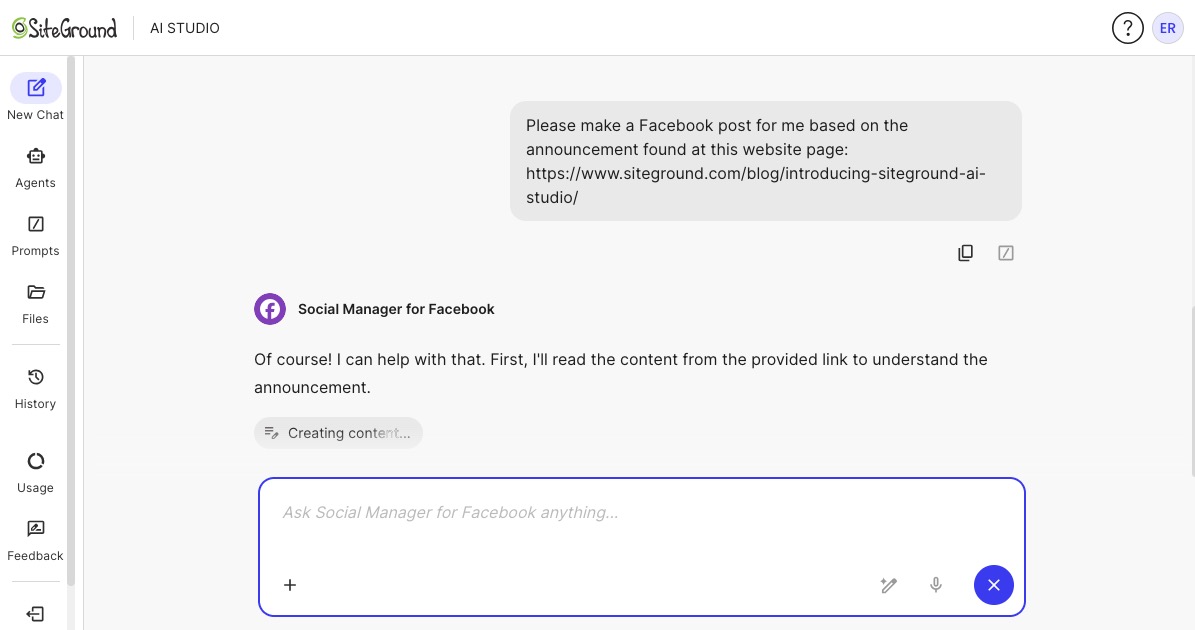
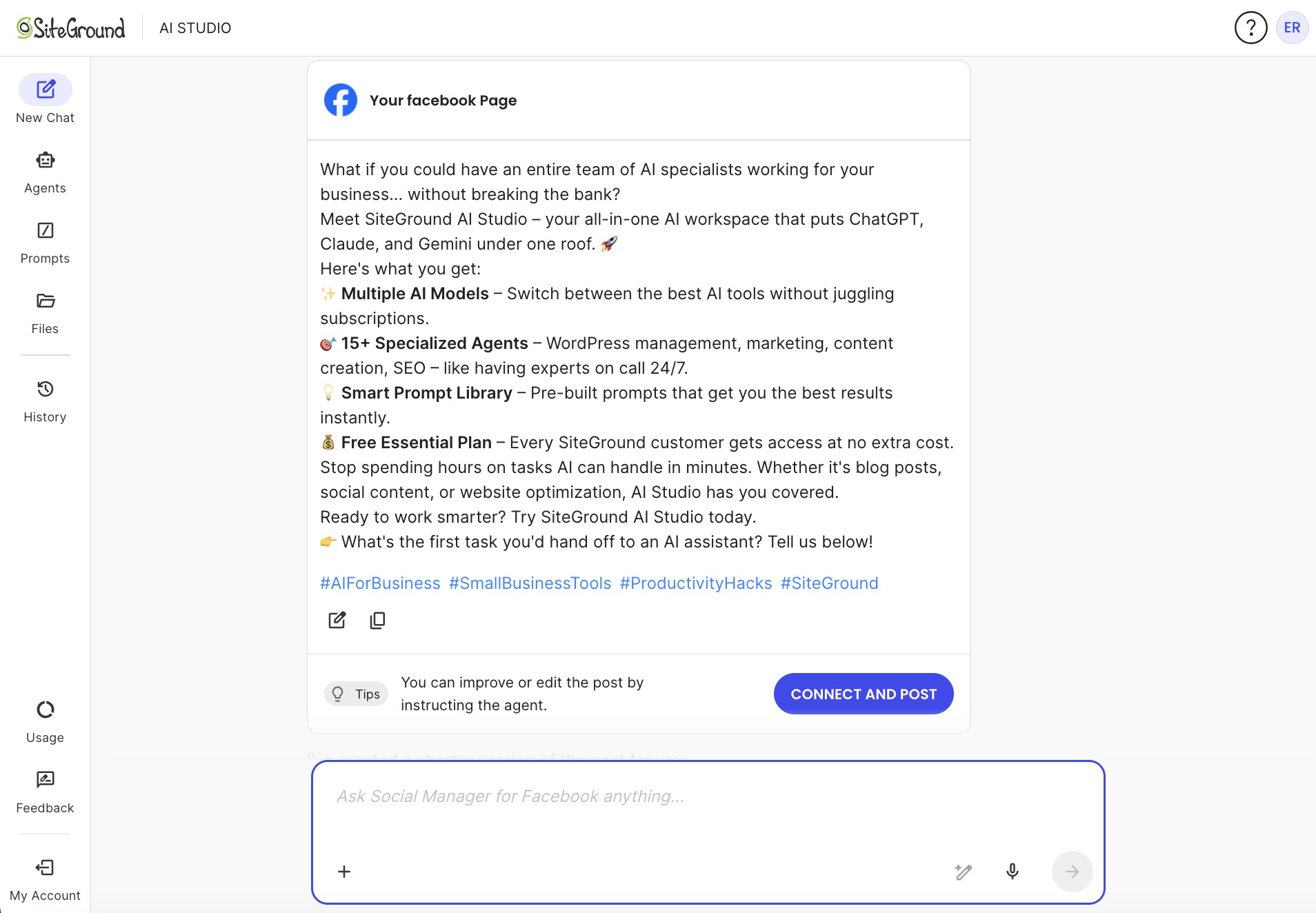
- Deploy platform-specific content at scale: Use social media AI agents (like the SiteGround Social Managers for Instagram, LinkedIn, and Facebook) to easily create posts customized to each channel while reinforcing your core positioning.
- Maintain steady activity and engagement: Post consistently, reply to comments, and monitor performance. Refine content based on what resonates. Consistency and responsiveness are signals AI actively notices.
SMB advantage
You can update messaging across all platforms in one afternoon. No committees, no approval chains. AI agents handle the messaging and execution (creating posts, adapting formats, publishing) while you control the strategy. Enterprise-level presence without enterprise headcount. While big competitors schedule meetings to discuss their social media marketing strategy, you’ve already implemented and refined yours.
Don’t wait for ChatGPT ads: build your AI presence now
The real threat isn’t ChatGPT ads. It’s being invisible when AI tools answer customer questions.
Enterprise competitors will outspend you in ad auctions, and that’s just reality. But they can’t outmaneuver you when it comes to building organic AI visibility. You have speed, agility, and the ability to implement changes while they’re still debating in committee. This is a tremendous advantage. AI tools amplify that advantage, giving you the efficiency to compete at enterprise scale without enterprise resources.
SiteGround AI Studio makes this even easier. With it, you gain access to a growing suite of specialized AI agents designed to amplify your team’s capabilities. Every SiteGround customer receives the Essential plan at no extra cost, which includes 20,000 monthly tokens, and the AI Agent for WordPress. Upgrading to the Plus plan unlocks 100,000 monthly tokens, 15+ specialized agents for SEO, content creation, reputation management, social presence, and more, plus a library of ready-to-use prompts, helping you build a comprehensive online footprint without expanding your headcount.
Getting started is simple. Access AI Studio from your dashboard and begin with the visibility audit. In just minutes, you’ll see where your business stands and get a clear roadmap for strengthening your organic AI presence.
ChatGPT ads: FAQs
AI visibility is how often and how favorably AI tools like ChatGPT mention your business when answering relevant customer questions. It matters because customer discovery is shifting to AI conversations. So if you’re invisible in AI responses, you’re invisible to potential customers regardless of your traditional SEO ranking.
OpenAI hasn’t released official pricing yet. Based on the competitive nature of paid search and the value of AI recommendations, expect ads on ChatGPT to be comparable to or more expensive than Google Ads in competitive industries. Growing small businesses should prepare for costs that favor enterprise advertiser budgets.
OpenAI is still rolling out ChatGPT advertising features. When available, ads will likely appear as sponsored recommendations within AI responses. The exact mechanics, bidding system, and targeting options haven’t been fully announced.
ChatGPT ads could work for SMBs with competitive ad budgets and specific, high-value keywords. However, organic AI visibility often delivers better ROI for small businesses because it doesn’t require ongoing ad spend and builds compound advantages over time. Focus on organic presence first, then consider supplementing with ads if budget allows.
It depends on your budget and how quickly you need results. ChatGPT advertising will likely favor businesses with substantial ad budgets. For most small businesses, building organic AI visibility first makes more sense because it’s sustainable, cost-effective, and builds long-term presence rather than paying for temporary placement.
No. Organic AI visibility is built through content quality, reputation, and consistency (not ad spend). AI tools help level the playing field by letting you create optimized content and manage presence at scale without enterprise-sized marketing budgets. Focus on being genuinely helpful to customers, and AI will take notice.
Definitely. Organic AI visibility is built through comprehensive, helpful content, strong online reputation, and consistent presence across multiple platforms. ChatGPT references authoritative sources when making recommendations, so if you’ve built that authority through content and reputation, you’ll get recommended without paying for ads.
Create content that directly answers customer questions, maintain positive reputation signals across reviews and social media, ensure consistent information across all online platforms, and demonstrate expertise through helpful how-to guides and problem-solving content. AI tools favor sources that comprehensively address customer needs.
Start with an AI visibility audit to understand your current position, create comprehensive content that answers customer questions, build and monitor your online reputation, and establish consistent presence across multiple platforms. These steps build organic visibility that benefits you whether there are ads in ChatGPT or not.




Comments ( 0 )
Thanks! Your comment will be held for moderation and will be shortly published, if it is related to this blog article. Comments for support inquiries or issues will not be published, if you have such please report it through our official channels of communication.
Leave a comment
Thanks! Your comment will be held for moderation and will be shortly published, if it is related to this blog article. Comments for support inquiries or issues will not be published, if you have such please report it through our official channels of communication.